
This researches the dose–response efficacy of two lignocellulosic coagulants (sawdust and rice husk) in comparison with ferric chloride for textile and tannery wastewaters treatment. The jar tests were conducted using six different doses of the coagulants (0, 2, 4, 6, 8, and 10 grams per 250 milliliters of wastewater) following a completely randomized factorial design, with each test repeated three times to ensure reliable results. The efficiency of the coagulants was evaluated based on several types of key parameters: pH, electrical conductivity (EC), turbidity, total suspended solids (TSS), total dissolved solids (TDS), hardness and extracts concentration into chloride, phosphate and to cadmium had been measured. The data demonstrated the influence of the coagulant type and dose on almost all parameters, as well as multiple wastewater × coagulant interaction effects (p ≤ 0.05). In general, sawdust proved to be better than rice husk and ferric chloride when applied for all physico-chemical properties and pollutant removal excepting pH adjustment, the turbidity, reduction in solids and cadmium removal^^. The maximum doses, especially 10 g, gave the highest enhancements for both wastewater kinds. The results demonstrate that lignocellulosic coagulants, especially sawdust, are feasible and economical substitutes for the conventional inorganic metal salts as primary treatment agents to textile and tannery industries which are confronted with increasing environmental demand. Importantly, the research indicates possible application of agricultural waste by-products by large water treatment industries.
| Published in | Science Futures (Volume 2, Issue 1) |
| DOI | 10.11648/j.scif.20260201.14 |
| Page(s) | 45-58 |
| Creative Commons |
This is an Open Access article, distributed under the terms of the Creative Commons Attribution 4.0 International License (http://creativecommons.org/licenses/by/4.0/), which permits unrestricted use, distribution and reproduction in any medium or format, provided the original work is properly cited. |
| Copyright |
Copyright © The Author(s), 2025. Published by Science Publishing Group |
Lignocellulosic Coagulants, Sawdust, Rice husk, Textile Wastewater, Tannery Wastewater, Wastewater Treatment Optimization
Factors | pH |
|---|---|
Wastewater (WW) | |
Tannery Wastewater | 7.70 a |
Textile Wastewater | 7.61 b |
Coagulants (C) | |
Sawdust | 7.64 |
Rice Husk | 7.66 |
Ferric Chloride | 7.66 |
Levels (l) | |
0 g | 8.47 a |
2 g | 7.91 b |
4 g | 7.62 c |
6 g | 7.51 c |
8 g | 7.25 d |
10 g | 7.16 d |
LSD (WW) (p ≤ 0.05) | 0.08 |
LSD (C) (p ≤ 0.05) | 0.10 |
LSD (L) (p ≤ 0.05) | 0.15 |
LSD WW × C (p ≤ 0.05) | 0.15 |
LSD WW × L (p ≤ 0.05) | 0.21 |
LSD C × L (p ≤ 0.05) | 0.26 |
LSD WW × C × L (p ≤ 0.05) | 0.37 |
F- value (WW) | 4.06* |
F- value (C) | 0.08NS |
F- value (L) | 77.27** |
F- value WW × C | 8.81** |
F- value WW × L | 0.00NS |
F- value C × L | 2.37* |
F- value WW × C × L | 0.83NS |
Factors | EC (µ S cm-1) |
|---|---|
Wastewater (WW) | |
Tannery Wastewater | 1376.90 a |
Textile Wastewater | 63.40 b |
Coagulants (C) | |
Sawdust | 709.13 c |
Rice Husk | 720.04 b |
Ferric Chloride | 731.30 a |
Levels (L) | |
0 g | 775.83 a |
2 g | 764.81 a |
4 g | 737.29 b |
6 g | 711.56 c |
8 g | 690.18 d |
10 g | 641.27 e |
LSD (WW) (p ≤ 0.05) | 7.01 |
LSD (C) (p ≤ 0.05) | 8.59 |
LSD (L) (p ≤ 0.05) | 12.15 |
LSD WW × C (p ≤ 0.05) | 12.15 |
LSD WW × L (p ≤ 0.05) | 17.19 |
LSD C × L (p ≤ 0.05) | 21.05 |
LSD WW × C × L (p ≤ 0.05) | 29.77 |
F- value (WW) | 139181** |
F- value (C) | 13.22** |
F- value (L) | 135.35** |
F- value WW × C | 8.72* |
F- value WW × L | 42.65** |
F- value C × L | 0.58NS |
F- value WW × C × L | 0.39NS |
Factors | Turbidity (NTU) |
|---|---|
Wastewater (WW) | |
Tannery Wastewater | 180.15 a |
Textile Wastewater | 135.67 b |
Coagulants (C) | |
Sawdust | 147.99 b |
Rice Husk | 161.86 a |
Ferric Chloride | 163.88 a |
Levels (L) | |
0 g | 302.50 a |
2 g | 210.50 b |
4 g | 154.17 c |
6 g | 114.98 d |
8 g | 88.14 e |
10 g | 77.16 f |
LSD (WW) (p ≤ 0.05) | 4.05 |
LSD (C) (p ≤ 0.05) | 4.96 |
LSD (L) (p ≤ 0.05) | 7.01 |
LSD WW × C (p ≤ 0.05) | 7.02 |
LSD WW × L (p ≤ 0.05) | 9.92 |
LSD C × L (p ≤ 0.05) | 12.15 |
LSD WW × C × L (p ≤ 0.05) | 17.18 |
F- value (WW) | 478.97** |
F- value (C) | 24.15** |
F- value (L) | 1191.66** |
F- value WW × C | 6.87* |
F- value WW × L | 397.40** |
F- value C × L | 1.60NS |
F- value WW × C × L | 1.46NS |
Factors | TSS (mg/L) |
|---|---|
Wastewater (WW) | |
Tannery Wastewater | 906.42 a |
Textile Wastewater | 474.58 b |
Coagulants (C) | |
Control | 940.50 a |
Sawdust (10 g) | 528.67 d |
Rice Husk (10 g) | 574.83 c |
Ferric Chloride (10 g) | 718.00 b |
LSD (WW) (p ≤ 0.05) | 21.81 |
LSD (C) (p ≤ 0.05) | 30.85 |
LSD WW × C (p ≤ 0.05) | 43.63 |
F- value (WW) | 1760.40** |
F- value (C) | 323.56** |
F- value WW × C | 34.39** |
Factors | TDS (mg/L) |
|---|---|
Wastewater (WW) | |
Tannery Wastewater | 2580.90 a |
Textile Wastewater | 621.70 b |
Coagulants (C) | |
Control | 2037.30 a |
Sawdust (10 g) | 1344.20 d |
Rice Husk (10 g) | 1450.00 c |
Ferric Chloride (10 g) | 1573.80 b |
LSD (WW) (p ≤ 0.05) | 32.03 |
LSD (C) (p ≤ 0.05) | 45.30 |
LSD WW × C (p ≤ 0.05) | 64.06 |
F- value (WW) | 16810.20** |
F- value (C) | 408.60** |
F- value WW × C | 32.61** |
Factors | TH (mg/L) |
|---|---|
Wastewater (WW) | |
Tannery Wastewater | 315.67 b |
Textile Wastewater | 948.08 a |
Coagulants (C) | |
Control | 742.67 a |
Sawdust (10 g) | 501.67 d |
Rice Husk (10 g) | 615.00 c |
Ferric Chloride (10 g) | 668.17 b |
LSD (WW) (p ≤ 0.05) | 18.12 |
LSD (C) (p ≤ 0.05) | 25.63 |
LSD WW × C (p ≤ 0.05) | 36.24 |
F- value (WW) | 5472.53** |
F- value (C) | 140.62** |
F- value WW × C | 2.54NS |
Factors | Cl-1 (mg/L) |
|---|---|
Wastewater (WW) | |
Tannery Wastewater | 11.67 b |
Textile Wastewater | 209.42 a |
Coagulants (C) | |
Control | 170.81 a |
Sawdust (10 g) | 60.46 c |
Rice Husk (10 g) | 99.38 b |
Ferric Chloride (10 g) | 111.51 b |
LSD (WW) (p ≤ 0.05) | 8.83 |
LSD (C) (p ≤ 0.05) | 12.50 |
LSD WW × C (p ≤ 0.05) | 17.67 |
F- value (WW) | 2249.04** |
F- value (C) | 120.13** |
F- value WW × C | 100.66** |
Factors | PO4-2 (mg/L) |
|---|---|
Wastewater (WW) | |
Tannery Wastewater | 6.78 a |
Textile Wastewater | 4.70 b |
Coagulants (C) | |
Control | 8.01 a |
Sawdust (10 g) | 4.19 d |
Rice Husk (10 g) | 5.17 c |
Ferric Chloride (10 g) | 5.61 b |
LSD (WW) (p ≤ 0.05) | 0.05 |
LSD (C) (p ≤ 0.05) | 0.08 |
LSD WW × C (p ≤ 0.05) | 0.11 |
F- value (WW) | 6032.00** |
F- value (C) | 3670.25** |
F- value WW × C | 37.53** |
Factors | Cd (mg/L) |
|---|---|
Wastewater (WW) | |
Tannery Wastewater | 4.59 a |
Textile Wastewater | 0.46 b |
Coagulants (C) | |
Control | 3.29 a |
Sawdust (10 g) | 1.55 c |
Rice Husk (10 g) | 2.43 a |
Ferric Chloride (10 g) | 2.85 ab |
LSD (WW) (p ≤ 0.05) | 0.45 |
LSD (C) (p ≤ 0.05) | 0.63 |
LSD WW × C (p ≤ 0.05) | 0.90 |
F- value (WW) | 375.72** |
F- value (C) | 12.05** |
F- value WW × C | 3.34* |
ANOVA | Analysis of Variance |
EC | Electrical Conductivity |
TSS | Total Suspended Solids |
TDS | Total Dissolved Solids |
LSD | Least Significant Difference |
pH | Potential of Hydrogen |
G | Gram (Unit of Measurement) |
μS cm-1 | Micro-Siemens per Centimeter (Unit of Electrical Conductivity) |
NTU | Nephelometric Turbidity Units |
mg/L | Milligrams per Liter |
FC | Ferric Chloride |
SD | Sawdust |
RH | Rice Husk |
LSD | (p ≤ 0.05): Least Significant Difference at 5% Significance Level |
| [1] | Fouda, S. H., E. A. El-Halim, and H. A. Ghany, Radiological and chemical hazards of persistent organic pollutants in the textile sector. Scientific Reports, 2025. 15(1): p. 20102. |
| [2] | Oros, A., Bioaccumulation and trophic transfer of heavy metals in marine fish: Ecological and ecosystem-level impacts. Journal of Xenobiotics, 2025. 15(2): p. 59. |
| [3] | Shamshad, J. and R. U. Rehman, Innovative approaches to sustainable wastewater treatment: a comprehensive exploration of conventional and emerging technologies. Environmental Science: Advances, 2025. |
| [4] | Zhu, J., et al., Benzene Ring-Driven Metal Hydrolysis and Floc Formation in Coagulation: Mechanistic Insights from Organic Structural Units. Environmental Science & Technology, 2025. |
| [5] | Baghel, R., A. K. Tiwari, and N. Srivastava, Recent advancement in heavy metals removal through electrocoagulation using porous and nonporous electrode materials. Separation Science and Technology, 2025: p. 1-26. |
| [6] | Hamilton, N. L., An Analysis of Drinking Water Quality Compliance and Public Water Systems in Louisiana: 2013–2023. 2024, Southern University and Agricultural and Mechanical College. |
| [7] | Radovic, S., et al., Life cycle assessment of new bio-based coagulant production for sustainable wastewater treatment. International Journal of Environmental Science and Technology, 2023. 20(7): p. 7433-7462. |
| [8] | Chakhtouna, H., et al., Recent advances in eco-friendly composites derived from lignocellulosic biomass for wastewater treatment. Biomass Conversion and Biorefinery, 2024. 14(11): p. 12085-12111. |
| [9] | Han, D. and Q. Hong, Emerging trends in cellulose and lignin-based nanomaterials for water treatment. International Journal of Biological Macromolecules, 2025: p. 141936. |
| [10] | Mishra, S. and M. Choudhary, Recent Updates of Eco-Friendly Heavy Metal Reduction Methods, in Heavy Metal Contamination in Wastewater and Its Bioremediation by Microbial-Based Approaches. 2025, Springer. p. 261-288. |
| [11] | Ali, S. K., et al., Eco-friendly solutions: a comprehensive review of natural coagulants for sustainable water treatment. Environmental Geochemistry and Health, 2025. 47(12): p. 535. |
| [12] | Abioye, O. M., et al., Plant-Derived Coagulants for Sustainable Wastewater Treatment: Applications and Environmental Impacts—A Review. NIPES-JSTR ISSUE, 2025. 7: p. 1580–1589-1580–1589. |
| [13] | Stanek, L. W., et al., Environmental public health research at the US Environmental Protection Agency: A blueprint for exposure science in a connected world. Journal of Exposure Science & Environmental Epidemiology, 2025. 35(4): p. 539-547. |
| [14] | de Souza Neri, T., et al., Journal of Environmental Science and Pollution Research. J. Environ. Sci, 2025. 11(1): p. 501-506. |
| [15] | Jammeli, L., G. Louhichi, and I. Khouni, Effectiveness of using Moringa oleifera seeds as a green coagulant for soya oil refinery wastewater ecological treatment: Box–Behnken design optimization. Euro-Mediterranean Journal for Environmental Integration, 2025: p. 1-25. |
| [16] | Tanui, I. C., et al., Occurrence and potential risk of steroid hormones in selected surface water and wastewater treatment plants in western Kenya. Environmental Pollution, 2025. 367: p. 125623. |
| [17] | Kurniawan, H. and N. Fadillah, The Effect of pH Variations and Aluminum Sulfate Coagulant Dosage on Reducing Turbidity in Salupangkang Tua River Water. Journal of Green Chemical and Environmental Engineering, 2025. 1(1): p. 20-27. |
| [18] | Jo, S., et al., Recent Advances in Wastewater Electrocoagulation Technologies: Beyond Chemical Coagulation. Energies (19961073), 2024. 17(23). |
| [19] | PROMI, J. T., T. I. JAHIN, and M. S. OISHI, Enhanced Turbidity Mitigation in Water Systems. 2025. |
| [20] | Varsani, V. G., et al., Unlocking the potential of lignocellulosic waste: a kinetic modeling approach for bio-coagulants in sewage water treatment. Environmental Technology & Innovation, 2024. 33: p. 103486. |
| [21] | Anju, T., S. R. Joy, and L. Lazar, Biomass Derived Materials Employed for Toxic Metal Removal from Aqueous Solution, in Handbook of Advanced Biomass Materials for Environmental Remediation. 2024, Springer. p. 151-177. |
| [22] | Xue, Y., et al., Co-hydrothermal carbonization of lignocellulose biomass and polyvinyl chloride: The migration and transformation of chlorine. Chemical Engineering Journal, 2022. 446: p. 137155. |
| [23] | Anirudhan, T., B. Noeline, and D. Manohar, Phosphate removal from wastewaters using a weak anion exchanger prepared from a lignocellulosic residue. Environmental science & technology, 2006. 40(8): p. 2740-2745. |
| [24] | Kayranli, B., Cadmium removal mechanisms from aqueous solution by using recycled lignocelluloses. Alexandria Engineering Journal, 2022. 61(1): p. 443-457. |
APA Style
Khan, U. U., Munir, S., Khan, A. A., Khan, M. A., Sha, Z. A. (2025). Dose-Optimized Evaluation of Lignocellulosic Coagulants and Ferric Chloride for Primary Treatment of Textile and Tannery Wastewaters. Science Futures, 2(1), 45-58. https://doi.org/10.11648/j.scif.20260201.14
ACS Style
Khan, U. U.; Munir, S.; Khan, A. A.; Khan, M. A.; Sha, Z. A. Dose-Optimized Evaluation of Lignocellulosic Coagulants and Ferric Chloride for Primary Treatment of Textile and Tannery Wastewaters. Sci. Futures 2025, 2(1), 45-58. doi: 10.11648/j.scif.20260201.14
AMA Style
Khan UU, Munir S, Khan AA, Khan MA, Sha ZA. Dose-Optimized Evaluation of Lignocellulosic Coagulants and Ferric Chloride for Primary Treatment of Textile and Tannery Wastewaters. Sci Futures. 2025;2(1):45-58. doi: 10.11648/j.scif.20260201.14
@article{10.11648/j.scif.20260201.14,
  author = {Ubaid Ullah Khan and Shafqat Munir and Abid Ali Khan and Muhammad Anwar Khan and Zafar Ali Sha},
  title = {Dose-Optimized Evaluation of Lignocellulosic Coagulants and Ferric Chloride for Primary Treatment of Textile and Tannery Wastewaters},
  journal = {Science Futures},
  volume = {2},
  number = {1},
  pages = {45-58},
  doi = {10.11648/j.scif.20260201.14},
  url = {https://doi.org/10.11648/j.scif.20260201.14},
  eprint = {https://article.sciencepublishinggroup.com/pdf/10.11648.j.scif.20260201.14},
  abstract = {This researches the dose–response efficacy of two lignocellulosic coagulants (sawdust and rice husk) in comparison with ferric chloride for textile and tannery wastewaters treatment. The jar tests were conducted using six different doses of the coagulants (0, 2, 4, 6, 8, and 10 grams per 250 milliliters of wastewater) following a completely randomized factorial design, with each test repeated three times to ensure reliable results. The efficiency of the coagulants was evaluated based on several types of key parameters: pH, electrical conductivity (EC), turbidity, total suspended solids (TSS), total dissolved solids (TDS), hardness and extracts concentration into chloride, phosphate and to cadmium had been measured. The data demonstrated the influence of the coagulant type and dose on almost all parameters, as well as multiple wastewater × coagulant interaction effects (p ≤ 0.05). In general, sawdust proved to be better than rice husk and ferric chloride when applied for all physico-chemical properties and pollutant removal excepting pH adjustment, the turbidity, reduction in solids and cadmium removal^^. The maximum doses, especially 10 g, gave the highest enhancements for both wastewater kinds. The results demonstrate that lignocellulosic coagulants, especially sawdust, are feasible and economical substitutes for the conventional inorganic metal salts as primary treatment agents to textile and tannery industries which are confronted with increasing environmental demand. Importantly, the research indicates possible application of agricultural waste by-products by large water treatment industries.},
 year = {2025}
}
TY  - JOUR
T1  - Dose-Optimized Evaluation of Lignocellulosic Coagulants and Ferric Chloride for Primary Treatment of Textile and Tannery Wastewaters
AU  - Ubaid Ullah Khan
AU  - Shafqat Munir
AU  - Abid Ali Khan
AU  - Muhammad Anwar Khan
AU  - Zafar Ali Sha
Y1  - 2025/12/26
PY  - 2025
N1  - https://doi.org/10.11648/j.scif.20260201.14
DO  - 10.11648/j.scif.20260201.14
T2  - Science Futures
JF  - Science Futures
JO  - Science Futures
SP  - 45
EP  - 58
PB  - Science Publishing Group
SN  - 3070-6289
UR  - https://doi.org/10.11648/j.scif.20260201.14
AB  - This researches the dose–response efficacy of two lignocellulosic coagulants (sawdust and rice husk) in comparison with ferric chloride for textile and tannery wastewaters treatment. The jar tests were conducted using six different doses of the coagulants (0, 2, 4, 6, 8, and 10 grams per 250 milliliters of wastewater) following a completely randomized factorial design, with each test repeated three times to ensure reliable results. The efficiency of the coagulants was evaluated based on several types of key parameters: pH, electrical conductivity (EC), turbidity, total suspended solids (TSS), total dissolved solids (TDS), hardness and extracts concentration into chloride, phosphate and to cadmium had been measured. The data demonstrated the influence of the coagulant type and dose on almost all parameters, as well as multiple wastewater × coagulant interaction effects (p ≤ 0.05). In general, sawdust proved to be better than rice husk and ferric chloride when applied for all physico-chemical properties and pollutant removal excepting pH adjustment, the turbidity, reduction in solids and cadmium removal^^. The maximum doses, especially 10 g, gave the highest enhancements for both wastewater kinds. The results demonstrate that lignocellulosic coagulants, especially sawdust, are feasible and economical substitutes for the conventional inorganic metal salts as primary treatment agents to textile and tannery industries which are confronted with increasing environmental demand. Importantly, the research indicates possible application of agricultural waste by-products by large water treatment industries.
VL  - 2
IS  - 1
ER  -
Department of Chemical Science, University of Lakki Marwat, Khyber Pakhtunkhwa, Pakistan
Department of Chemistry, Minhaj University, Lahore Punjab, Pakistan
Department of Chemical Science, University of Lakki Marwat, Khyber Pakhtunkhwa, Pakistan
Department of Chemical Science, University of Lakki Marwat, Khyber Pakhtunkhwa, Pakistan
Department of Agricultural Chemistry & Biochemistry, University of Agriculture, Khyber Pakhtunkhwa, Pakistan
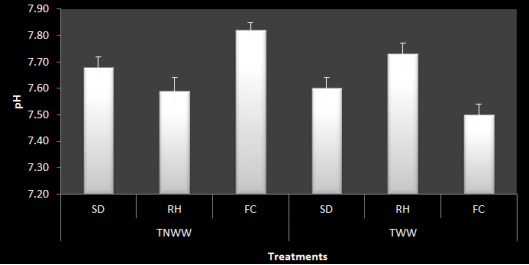
Figure 1. Interactive effect of wastewaters and various coagulants on the pH.
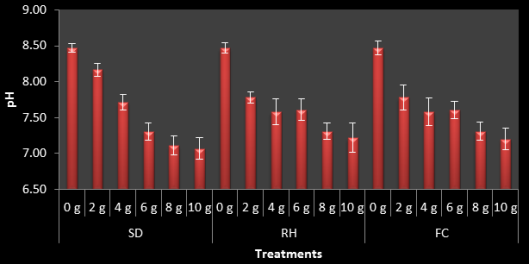
Figure 2. Interactive effect of various levels of organic and inorganic coagulants on the pH of wastewaters.
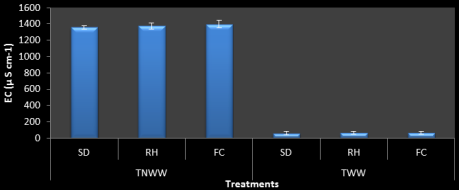
Figure 3. Interactive effect of wastewaters and various coagulants on the EC (µ S cm-1) of wastewaters.
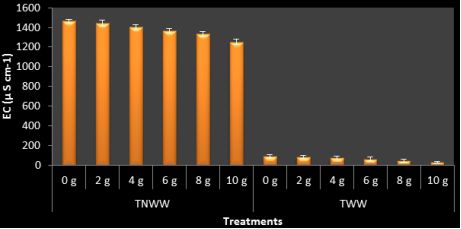
Figure 4. Interactive effect of different levels of coagulants on the EC (µ S cm-1) of wastewater.
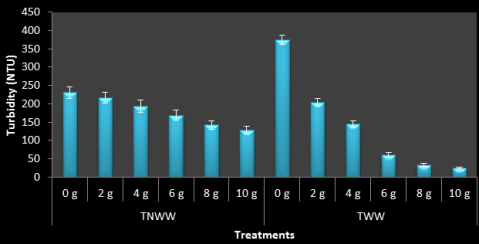
Figure 5. Interactive effect of different levels of coagulants on turbidity of wastewater.
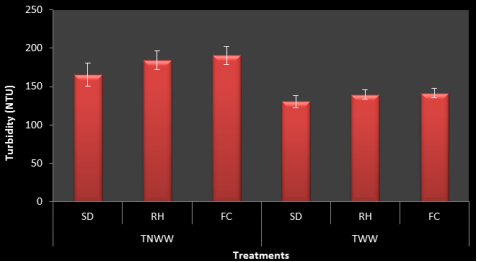
Figure 6. Interactive effect of organic and inorganic coagulants on turbidity of various wastewaters.
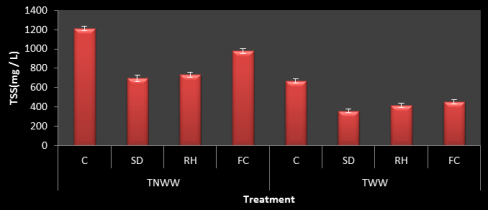
Figure 7. Interactive effect of organic and inorganic coagulants on total suspended solids (mg/L) of various wastewaters.
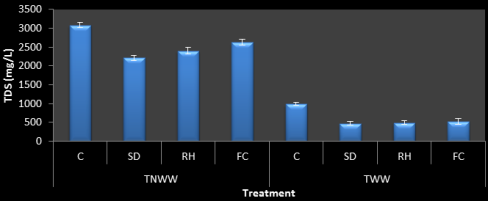
Figure 8. Interactive effect of organic and inorganic coagulants on total dissolved solids (mg/L) of various wastewaters.
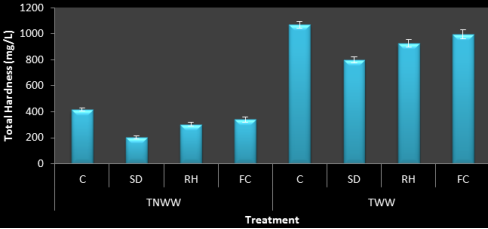
Figure 9. Interactive effect of organic and inorganic coagulants on total hardness (mg/L) of various wastewaters.
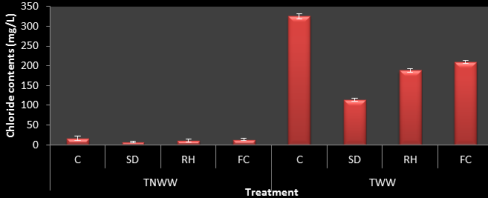
Figure 10. Interactive effect of organic and inorganic coagulants on chloride contents (mg/L) of various wastewaters.
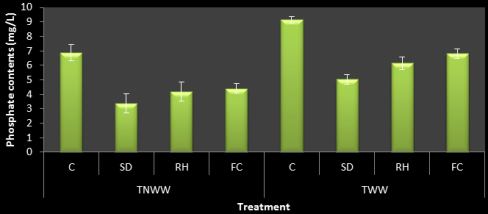
Figure 11. Interactive effect of organic and inorganic coagulants on phosphate contents (mg/L) of various wastewaters.
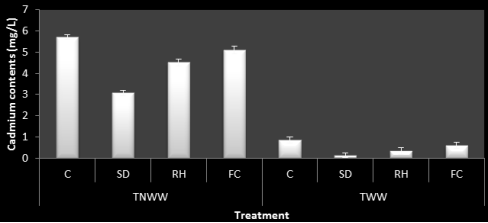
Figure 12. Interactive effect of organic and inorganic coagulants on cadmium contents (mg/L) of various wastewaters.




 Share This Article
 Twitter
 Linked In
 Facebook
 Copy
Copy Download