Research Article | | Peer-Reviewed

Assessment of Constraints and Farmers’ Perception in Production and Marketing of Improved Forages in the Central Ethiopia Region

Received: 13 November 2025     Accepted: 8 December 2025     Published: 29 December 2025
Views:       Downloads:
Abstract

One of the primary causes of Ethiopia's poor livestock production performance is an inadequate supply of feed. Besides, its productivity is poor due to low adoption and utilization of improved forages and forage seed production. The objective of this study was to assess constraints and farmers’ perceptions in the production and marketing of improved forage production in the Gummer and Silti districts, Central Ethiopia Region. To collect the data, primary and secondary data sources were used. In addition, 133 sample households were used to collect the data using a semi-structured questionnaire. Descriptive statistics were employed to analyze the collected data. The study results revealed that about 3.4% of the cropland in the study region was used by the households to grow fodder crops. The two primary enhanced forage crops cultivated in the research region were desho and elephant grass, and they have contributed 60.2% and 33.1%, respectively. Furthermore, the results showed that land shortage (56.5%), water scarcity (28.2%), seed scarcity (8.4%), irregular extension service (5.4%), and high cost of forage seed (1.5%) were the main constraints for access to and utilization of forage technology in the study area. Farmers’ perception toward improved production score results indicated that 87.2% of participants were not interested in producing improved forage in full engagement, 56.3% felt improved forage production would compete with crop production, 42.9% decreased soil fertility, and 0.8% of local breeds refused to eat leguminous improved forage species. It needs to improve the land use policy and implementation practices, addressing training, access to forage seed, and extension services. Additionally, working together between agricultural extension and the agricultural research system should help to increase the technology's acceptance and reduce the gap between the government and technology users/farmers.

Published in Science Futures (Volume 2, Issue 1)
DOI 10.11648/j.scif.20260201.17
Page(s) 76-86
Creative Commons

This is an Open Access article, distributed under the terms of the Creative Commons Attribution 4.0 International License (http://creativecommons.org/licenses/by/4.0/), which permits unrestricted use, distribution and reproduction in any medium or format, provided the original work is properly cited.

Copyright

Copyright © The Author(s), 2025. Published by Science Publishing Group

Keywords

Constraints, Farmers’ Perception, Marketing, Improved Forage

1. Introduction
About 40% of the world's agricultural production comes from livestock, which are essential to the livelihoods and food security of roughly 1 billion people in developing nations. It provides 25% of dietary protein, 15% of total food energy, and some minerals that are not found in plants. . There are an estimated 60.39 million cattle, 31.3 million sheep, 32.74 million goats, 11.32 million horses, and 1.42 million camels in Ethiopia. . Additionally, more than 85% of the Ethiopian population resides in rural areas, and their economy relies heavily on livestock production systems . Despite Ethiopia having a large livestock population, its production and productivity are low due to shortages in the quantity and quality of feed resources . In the country as a whole, the existing feed does not meet the amount required by livestock. However, the country's consumer demand for livestock products is expected to increase, and it would be challenging to meet this need unless immediate action is taken. The primary feed resources for livestock are natural pastures and crop residues, which are often low in quantity and quality, limiting sustainable animal production . Low livestock production performances in Ethiopia are mostly caused by two critical factors: limited feed supply and poor feed quality. Besides, its productivity is poor due to low adoption and utilization of improved forages and forage seed production, awareness problems, erratic rainfall, and related constraints. Moreover, shortage of land, shortage of improved forage seed, the reluctance of most farmers and lack of well-organized extension services hindered improved forage development. The acceptance and use of enhanced forages by farmers is extremely low, despite years of research and extension efforts. Utilizing enhanced forages improves soil fertility and erosion on marginal lands, minimizes the stress on natural pastures, increases carbon sequestration to slow down climate change, promotes system sustainability, and strengthens natural resources and system resilience . More than 90% of the livestock's diet consists of hay, crop residues, and natural grass; in contrast, enhanced forages make up less than 0.35% of the diet, except the Harari region, where it is 1.68%. Although the use and significance of improved fodder species and types are currently negligible, they will soon be essential to the sustainable intensification of animal production. .
Farmers incorporate forage production into the farming system in order to alleviate the scarcity of livestock feed in the crop-livestock production system. The availability of a consistent supply of high-quality forage seeds and cuttings is essential for establishing dependable fodder production. By increasing the quantity of nitrogen available for uptake by related grasses and the possibility of sustainable development, improved forage legumes can increase pasture productivity. Soil nutrient depletion and poor nutritive forage are the major causes of low crop and animal productivity in farms in Ethiopia, especially in highland areas. Improved forage crops play a very important part in agriculture. Their cultivation is being deservedly extended, and the increase in acreage devoted to their growth will undoubtedly continue until their full utilization as soil renovators and as cheap producers of fodder rich in nitrogenous compounds is attained. To enhance the productivity of the livestock sector, a number of constraints need technical solutions and policy interventions. Feed shortages, both in quantity and quality, are the most limiting factor. Unless feed availability and quality are improved, livestock development goals will not be realized. Similarly, in the study area, the livestock feeding technique is based almost entirely on crop residue and natural pasture. The feed availability and nutritional dynamics of pasture forages have a significant impact on the natural pasture-based and crop residue feeding system. The introduction and production of high-yielding and nutritious improved forage species and seed multiplication are important issues to minimize feed shortage in the study area. Hence, this study aims to assess the constraints and farmers' perceptions of improved forage production and marketing in the central Ethiopia region and forward possible recommendations.
2. Materials and Methods
2.1. Description of the Study Area
The study was conducted in Gumer from the Gurage zone and Silti districts from the Silti zone of the Central Ethiopia Region. From each district, two kebeles were purposely selected based on the practice of improved forage production and utilization. Gumer district is one of the Gurage zones of the Central Ethiopia Region. Located around 220 kilometers south of Addis Ababa, the capital of Ethiopia. This district is characterized by a high altitude range between 2,540 and 3,178 meters above sea level, receiving an average annual rainfall of 1,600 mm and an average temperature ranging from 13°C to 30°C. The land use is predominantly arable, covering 18,731 ha. Forest and grazing lands cover 1,901 ha and 618 ha, respectively, for a total of 21,250 ha. The major soil types of the district are vertisols (73%), leptosols (21%), and nitisols (6%). The area is characterized by bimodal rainfall distribution in which June to September is the main rainy season, whereas March and April are months of the Belg (short rainy season). November, December, January, and February are the dry months. The Silti district is located in the Siltie Zone, Central Ethiopia Region, about 160 km south of Addis Ababa, the capital of Ethiopia. The total area of the district is about 53,112 ha, of which 25,635 ha is annual cultivated land, 11,221 ha is perennial, 6,365 ha is grazing land, 2,987 ha is forest, and 6,904 ha is bush land. The district agro-ecology has 16% highland and 84% midland. The soil type has 73% clay loam and 27% silt. The majority of farming systems practiced are mixed farming. Major annual crops are wheat, teff, and maize, and major perennial crops are enset and chat. The altitude of the district ranges from 1819 to 3031 meters above sea level, with a rainfall amount of 900-1400 mm per year. Mean annual temperature range of 18°C to 22.5°C. There are two cropping seasons, namely, Belg (short rainy season) and Meher (main rainy season). The short rainy season lasts from March to May, while the main rainy season is from June to September.
2.2. Sampling Technique and Sample Size
A multi-stage technique was employed to select the sample for this study. In the first stage, Gumer and Silti districts were selected based on their improved forage production potential. In the second stage, two kebeles were selected from each district using simple random sampling among improved forage-producing kebeles. Finally, the total respondents was selected using simple random sampling according to the proportional size of the population involved in the production of more nutritious forage. In the end, from the 886 improved forage producer households in these four kebeles, 133 improved forage producer farm household heads were selected randomly using the Yamane formula. According to , the following formula is used.
n=N1 + N(e)2=8861 + 886(0.08)2=132.83133
Where n is the sample size, N is the target population size of forage producers in the districts, which was 886, and e is the level of precision, which was 8%, due to no more variations among the population.
2.3. Data Source, Type, and Collection Methods
In this study, both qualitative and quantitative data were used from primary and secondary sources. Primary data was gathered by semi-structured household survey questionnaires, focus groups, key informant interviews, and informal surveys. Furthermore, secondary data was gathered through the examination of both published and unpublished papers. Based on proportion, one hundred thirty-three farmers from four improved forage-producing Kebeles.
2.4. Method of Data Analysis
The collected data were analyzed using descriptive statistics, including maximum, minimum, mean, standard deviation, percentages, and frequency, to examine the socioeconomic and demographic features of the households of forage producers. The results were displayed as tables and graphs.
3. Result and Discussion
3.1. Description of Demographic & Socio-Economic Variables
The study attempts to determine whether gender differences exist in the application of enhanced forage technologies. Table 1 shows that enrollment levels for households headed by men and women differed, with more male farmers than female farmers. The findings showed that, of all the producers who responded, 87.2% of households were headed by men and 12.8% by women. This suggests that families headed by men were more likely than households headed by women to adopt enhanced forage technologies in the research area. The considerable variability was shown to be statistically significant within both categories of households. This could be because the technology is labor-intensive. Male-headed households are therefore better off than female-headed households since males are heavily involved in fodder production and, as a result, have access to information and training. However, the responsibility of childcare, cooking, and housework falls on households led by women.
Regarding age category, 47.4% of the households were 31-45 years old, 36.1% were over 45 years old, and 16.5% were 18-30 years old. From the result, one could deduce that the majority 47.4% of the respondent were 31-45 age group participate in improved forage production better than other age groups. 94% of the respondents were married, 3% widowed, 2.3% single, and 0.7% divorced. Based on the survey results, a positive attitude toward a new technology, interest, and instigation to put it into practice were the main requirements. Married couples could accept and participate in implementing new technology; by discussion and sharing ideas, each couple decides without reluctance. In addition, 4-7 member family sizes constitute 53.4%, >7 member family sizes hold 35.3% and 1-3 member family sizes score 11.3%.
Table 1. Description of Demographic & Socio-Economic Variables.

Variable

Categories

Frequency

Percentage

Gender

Male

113

87.2

Female

20

12.8

Age

18-30

22

16.5

31-45

60

47.4

>45

51

36.1

Marital Status

Single

3

2.3

Married

125

94

Divorced

1

0.7

Widowed

4

3

Family size

1-3

15

11.3

4-7

71

53.4

>7

47

35.3

Occupation of respondents

Crop production

3

2.3

Mixed Farming

130

97.7

Level of education

Illiterate

23

17.4

Read and write

28

13.5

1-6

52

39.1

7-8

20

15

9-12

20

15

Source: own computation survey (2024).
According to , technology adoption rates increased significantly with the stage of education and family size and decreasing distance from market or trade centers. A large family size could share tasks among family members/labor division exists, and family members participate in different activities. Labor division decreases workload. Additionally, 97% of the respondents were involved in crop production and animal rearing, while the remaining 3% were also involved in crop production. Concerning level of education, for 39.1% of respondents their education level was laid on grade 1-6, 17% Illiterate, 15% were in grade 7-8, 15% grade 9-12, and 13.5% were able to read and write.
3.2. Distribution of Land Used for Cultivation in the Study Area
Mixed crop and livestock farming represent the majority of farming activities in the studied areas. Landholding of the study areas was total cultivated land, with a mean of 0.876 ha, which indicated that smallholder farmers individually owned less than one ha; 0.25 ha was minimum and few farmers owned 3 ha, which was the maximum. Land allocated for cultivation of improved forage: mean 0.035 ha, minimum 0.01 ha, and maximum 0.25 ha. From the indicated figures, one could suggest farmers allocate less land size for cultivation of improved forage. The average total landholding of respondents in the current study was much lower than the national average landholding size of 2.5 ha. . regarding the amount of improved forage produced per year: mean 780.23 kg, minimum 40 kg, and maximum 12000 kg. The assessment result indicated that there is a huge difference among farmers in allocating land for production of improved forage and production amount. The annual income of respondents showed variation based on type of economic activities that they participated (Table 2).
Table 2. Land Distribution in the Study Area.

Variable

Mean

Std. Dev.

Min

Max

Total cultivated land (ha)

0.876

0.584

0.25

3.00

Cultivated land by improved forage (ha)

0.035

0.053

0.01

0.250

Improved forage production per year (kg)

780.23

1786.197

40

12000

Annual Income of individual household (ETB)

20849.62

16601.157

5000

80000

Source: own computation survey (2024).
3.3. Challenges in Animal Production
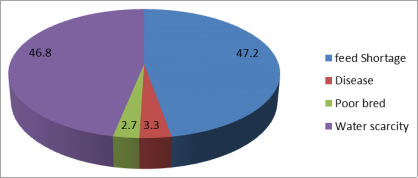
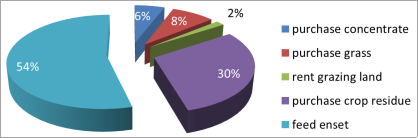
The assessment identified different livestock production challenges in the study area: 98.5% of the respondents indicated that the existence of challenges in livestock production, with feed shortage in first rank (47.2%), water shortage second (46.8%), disease third (3.3%), and poor breed fourth (2.7%) (Figure 1). Low forage yield, restricted forage species diversification, and inefficient use of feed resources were identified as the main causes of the feed deficit. Inadequate water harvesting methods, as well as current infrastructure and technical weaknesses in the wise utilization of limited water resources, may be contributing factors to water scarcity issues. Inadequate veterinary treatment and inadequate technical skills may be the cause of disease constraints. Lack of advancement in breed development initiatives may be linked to issues with animal breed performance. These issues were consistent with reports of the districts of Horro and Guduru.. The majority of farmers considered breed performance to be the least significant issue. Lower priority livestock breed performance issues revealed local breeds' unrealized productive potential in the face of sound management techniques.. Regarding feed shortage and coping mechanisms, farmers took different measures to alleviate feed shortage: 54.2% fed enset, 30% purchased crop residue, 8.3% purchased grass, 5.8% purchased concentrate, and 1.7% rented grassland (Figure 2).
Figure 1. Challenges of Animal Production in the Study Areas.
3.3.1. Measures Taken to Alleviate Problems of Feed Shortage
Farmers practiced different coping mechanisms to reduce the problem of feed shortage, like feed purchasing (concentrate, grass, renting grazing land, and crop residues) and feeding enset (Ensete ventricosum).
Figure 2. Measures Taken to Alleviate Problems of Feed Shortage.
3.3.2. Major Feed Resources in the Study Area
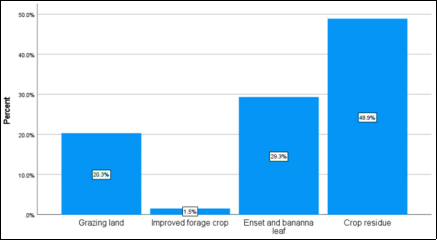
In both districts, the survey results depicted that the source of available livestock feed is mainly based on crop residues, which accounted for 48.9%; enset and banana leaf, 29.3%; grazing land (natural pasture), 20.3%; and improved forage, forage 1.5%. In the Gumer district, major sources of animal feed were annual crop residues. During dry periods, farmers used enset as fodder for their animals. In the Silti district, crop residues (maize stalk and wheat straw) served as major animal feed; when feed shortages occurred, as well as during the dry season, banana leaves were used as feed.
Figure 3. Major Animal Feed Sources in the Study Areas.
3.4. Experiences of Improved Forage Cultivation in the Research Area
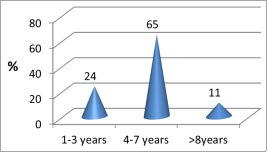
Animal feed shortages could be addressed by increasing forage production, but this is hindered by several factors, including small landholdings, the prioritization of food crop production, the scarcity of different forage seed species, and a lack of knowledge about forage species and their production systems. The lack of a more robust and effective mechanism for the provision and transmission of forage seeds in the region made the situation worse. In order to create sustainable forage seed transfer systems, concerned stakeholders must pay attention to this. Concerning the experience of improved forage cultivation in this study area, it has exhibited various years of experience. In different years, forage farmers began using various improved forage resources in the last one to three years; 24% of the respondents reported using better forage technologies.
Source: own computation (2024).

Download: Download full-size image

Figure 4. Improved Forage Growing Experiences of Producers.
Households with enhanced cattle ownership were directly correlated with the other majority of homes (65%) who had been using better fodder for four to seven years, and the remaining households (11%) who had been using it for eight or more years (Figure 4). Therefore, one without the other is ineffective, and focus group discussions confirmed this conclusion.
3.4.1. Forage Species Cultivated in the Study Areas
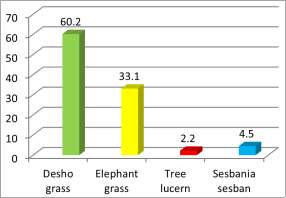
In the study areas, different improved forage species had been cultivated for two decades. Figure 5 below shows that farmers had adopted limited forage species, from grass species like desho and elephant grass to legumes like tree lucerne and sesbania sesban. Silti district produced elephant and desho grasses from grass species and sesbania sesban from leguminous species, while relative to other districts in Gumer district, desho grass and tree Lucerne were adopted widely.
Figure 5. Improved Forage Species Were Cultivated in the Study Area.
3.4.2. Source of Improved Forage Seed
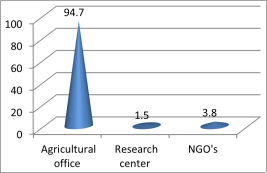
About 94.7% of the households in the research area obtained their enhanced forage seed from the government office of agriculture via its extension services. For roughly 3.8% of the households, NGOs were the second source of improved forage seed technology; 1.5% of the households additionally obtained it from research centers (Figure 6). Through directly demonstrating the most promising materials to the community so far, agricultural research centers have also contributed to the development of knowledge about enhanced household fodder technology. With the exception of a few instances where farmers bought from others, the forage seed and planting material transportation system was free.
Figure 6. Source of Improved Forage Seed.

3.4.3. Constraints of Improved Forage Technologies
Only a small percentage of homes have already begun using improved forage technologies; there are key factors that challenge the cultivation of enhanced forage. Land scarcity is one of the five main causes cited by farmers, as seen in Table 3. (56.5% of the households), scarcity of water (28.2%), unavailability of sources/technology/seed shortage (7.5%), irregular extension service (8.4%), and the problem of high cost of forage seed (1.5%) had been reported (Table 3). The first two reasons were found to be critical challenges for the adoption of this particular technology in the study area. The basic reason for this occurrence is unwillingness to allocate land for forage production and supply shortage due to the unavailability of reliable formal improved forage multiplication and distribution centers in the region. The government has given due focus to the establishment of seed multiplication of improved forage crop varieties at research center levels with limited seed varieties and less budget. This kind of work could not reach the large mass of the population. The other major reason was related to irregular extension service and the high cost of improved forage. This study is in line with the study of . The result shows that the shortage of land is the major challenge explained by the sample respondents.
Table 3. Major Constraint for Cultivating Improved Forage Technologies.

Variable

Frequency

Percent

Shortage of land

75

56.5

Shortage of planting materials

11

8.4

Irregular extension service

7

5.3

High cost of forage seed

2

1.5

Scarcity of water

38

28.2

Source: own computation (2024).
Season of feed shortage occurrence and feeding methods
The respondents approved the occurrence of feed shortage during the dry season; 63.3% of the respondents suggested that the shortage of feed occurs in the winter season (December–February), 26.7% in March to May, 6.7% in the summer season (June–August), and 3.3% in September-November. Furthermore, they described forage storage and preservation methods: 40.6% of respondents stored it compactly in-house, 39.8% shipped it as hay, and 19.5% baled it in-house. While 94% of respondents preserved it as hay and 6% as silage. Regarding feeding methods majority of respondents were fed as green feed, which is shown below in Table 4.
Table 4. Feed Shortage Occurrence Season and Feeding Methods.

Variable

Categories

Frequency

Percentage

Seasonal feed shortage occurred

First began (Sep-Nov)

4

3.0

Second bega (Dec-Feb)

87

65.4

Belg (Mar-May)

34

25.6

Meher (Jun-Aug)

8

6.0

Forage storage method

Baled in-house

26

19.5

Hip as a hay

53

39.8

Compacted in-house

54

40.6

Preservation method

Hay

125

94

Silage

8

6.0

Forage feeding method

As green feed

71

53.4

Mix with hay

18

13.5

Mix with crop residue

28

21.1

Mix with the concentrate

2

1.5

As green and hay

14

10.5

Source: own computation (2024).
3.4.4. Perception and Practice of Improved Forage Production
Farmers' perception of improved forage production was crucial for its adoption. This study showed an understanding of how farmers viewed and utilized improved forages to address livestock feed shortages. The perception score result indicated that 98.5% of the respondents had an understanding of improved forage production, and 98% had awareness of the use of improved forage. Concerning interest in forage production, 87.2% of participants indicated the existence of a lack of interest in producing improved forage: 56.3% felt improved forage production would compete with crop production, 42.9% decreased soil fertility, and 0.8% of local breeds refused to eat leguminous improved forage species (Table 5). On the other hand, according to , farmers in the study areas had a good perception about improved forage production, as forages do have multiple functions for the household in the form of soil conservation, fodder production, and income generation.
Table 5. Perception of Farmers Towards Improved Forage Production.

Variable

Response

Frequency

Percentage

Understand improved forage production

Yes

131

98.5

Awareness of the use of improved forage

Yes

130

98

Feeling not to produce improved forage

Yes

116

87.2

Improved forage production decreased soil fertility

Yes

57

42.9

It computed crop production

Yes

75

56.3

Local bred refused to eat improved forage

Yes

1

0.8

Source: own computation (2024).
3.4.5. Marketing of Improved Forage Seed and Fodder
Regarding fodder and forage, seed marketing, selling, and buying activity was carried out in the study area: 79% of selling and buying took place on the farm, 11.3% at the marketplace, 6% at the temporary market, and 3.7% at the nearby town. Market actors were 91.7% farmers, 5.3% agricultural offices, and 3% research centers. Market information was transferred from 37.5% DAs, 39.9% from farmers, and 22.6% community leaders. 100% of fodder and forage seed buyers were farmers. 93.2% of respondents participated in the buying and selling process. 84.2%, 6.8%, and 9% of respondents benefited from the production of improved forage in milk production, changes in the living standard, and social value, respectively.
Table 6. Institutional Characteristics.

Variables

Categories

Frequency

Percent

Selling and buying a place

At market place

15

11.3

On farm

105

79

At the temporary market

8

6.

At nearby town

5

3.7

Market actors

Farmers

122

91.7

Agricultural office

7

5.3

Research centers

4

3

Market information

DAs

50

37.5

Farmers

53

39.9

Community leaders

30

22.6

Forage seed buyers

Farmers

124

93.2

Animal husbandry’s

6

4.5

Brokers

3

2.3

Access to credit

Yes

53

39.8

Benefits from forage production

Milk production increased

112

84.2

The living standard has improved

9

6.8

Social value increased

12

9.0

Source: own computation (2024).
3.4.6. Forage Seed Delivery System
Below the table shows that almost 91.7% of respondents responded that they had access to improved forage seed and planting material/seed and distributed it as a gift. Moreover, 92.5% of respondents witnessed the existence of improved forage demonstration and multiplication sites at the kebele level, and demonstration and multiplication activity was carried out, 85% on the FTC and 15% on model farmers.
Table 7. Forage Seed Delivery System.

Variables

Response

Frequency

percentage

Access to improved forage seed

Yes

122

91.7

Forage seed from organizations

Gift

132

99.2

Through sale

1

0.8

Demonstration and multiplication site

Yes

123

92.5

Demonstration carried out

On FTC

114

85.7

On model farmers

19

14.3

Source: own computation (2024).
4. Conclusions
This study's main objective was to assess the barriers and perspectives of farmers on better forage production and marketing in the study areas. 87.2% of the total adopters' respondents were male-headed families, while 20 (12.8%) were female-headed households, according to the study's assessment of gender differences in the adoption of better forage technology. Farmers depended on various sources of animal feed, most of which were obtained in their locality and from their farms. Crop residues, enset and banana leaves, natural pasture, and improved forage as sources of animal feed. Improved forage contributed 1.5%; the main species of improved forage were desho (Pennestum pedicellatum) and elephant (Pennisetum purpureum) grass, which accounted for 60.2% and 33.1%, respectively. Sampled households were allocated only 3.4% of farmland (0.035 ha on average) from their total farmland for the production of improved forage crops. 94.7% of the total interviewed households had awareness of improved forage technology, while the remaining 5.3% had not. Several factors affect the adoption. It was found that land shortage (56.5%), water scarcity (28.2%), and a lack of source technology (seed scarcity (8.4%), irregular extension service (5.4%), and high cost of forage seed (1.5%)) were critical factors in the study area for the production of improved forage.
Therefore, for improvement and intensification, an improved forage land use policy implementation should be practiced. Effective extension service in terms of seed supply, awareness building, and regular technical backups is important and should be emphasized to ensure sustainable production and utilization of improved forage crops in the study areas. Likewise, working closely with respective regional research centers, agricultural offices, and development organizations should be considered most important to increase smallholder awareness of the technology and enhance the technology acceptance.
5. Significance Statement
This study identifies the significant role of forage production, which can be beneficial for smallholder farmers, extension agents, and policymakers striving to improve forage productivity in Ethiopia. By identifying key determinants, the study offers valuable insights into optimizing existing resources without additional input costs. It further emphasizes that promoting forage production levels and minimizing its constraints not only improves yield but also fosters knowledge sharing and collective resource use among farmers. This study will help the researchers to uncover the critical areas of input utilization and farming practices that many researchers were not able to explore. Thus, a new theory on production constraints on agricultural transformation may arrive.
Abbreviations

CSA

Central Statistical Agency

DAs

Development Agents

FAO

Food and Agricultural Organization

HA

Hectares

ILRI

International Livestock Research Institute

KG

Kilogram

NGO

Non-Governmental Organization

Acknowledgments
The authors would like to express their sincere gratitude to the Central Ethiopia research institution for providing the necessary assistance in completing this research paper.
Author Contributions
Haider Abdo: Formal Analysis, Methodology, Software, Supervision, Writing – original draft, Writing – review & editing
Emran Temam: Conceptualization, Data curation, Formal Analysis, Methodology, Writing – original draft
Funding
This research not received any external funding.
Data Availability Statement
The data used for this study are available from corresponding author upon the request.
Conflicts of Interest
The authors declare no conflicts of interest.
References
[1] FAO. 2009. The state of food and agriculture 2009. Livestock in the balance. Food and agriculture organization of the United Nations Rome.
[2] CSA, Agricultural Sample Survey: Volume II Report on Livestock and Livestock Characteristics. 2018. Central Statistical Agency (CSA), Addis Ababa, Ethiopia.
[3] Birhan, M. and Adugna, T. 2014. Livestock feed resources assessment, constraints and improvement strategies in Ethiopia. Middle-East Journal of Scientific Research, 21(4), pp. 616-622.
[4] Tegegne, F. and Asefa, G. 2010. Feed Resource Assessment in Amhara Regional State. Ethiopian Sanitary and Phytosanitary Standards and Livestock Meat Marketing Program (SPS-LMM), Texas A&M University System.
[5] Yayneshet, T. 2010. Feed Resources Availability in tigray region, northern Ethiopia, for production of export quality meat and livestock. Ethiopia Sanitary & Phytosanitary Standards and Livestock & Meat Marketing Program (SPS-LMM) Report. 77pp.
[6] Tessema Zewdu, Baars R, Alemu Yami, Dawit N. 2002. In sacco dry matter and nitrogen degradability and their relationship with in- vitro dry matter digestibility of Napier grass (Pennisetum purpureum (L.) Schumach) as influenced by plant height at cutting. Australian J. Agric. Research, 53: 7-12.
[7] Tessema, Z. and Baars. R. M. T. 2004. Chemical composition, in vitro dry matter digestibility and ruminal degradation of Napier grass (Pennisetum purpureum (L.) Schumach.) mixed with different levels of Sesbania sesban (L.) Merr.). Animal Feed Science and Technology 117: 29-41.
[8] ILRI. 2009. Outcome story, production, and Distribution Networks, Avail forage planting materials to smallholder dairy producers in East Africa.
[9] FAO. 2018. Ethiopia: Report on feed inventory and feed balance, 2018. Rome, Italy. 160 pages. License: CC BY-NC-SA 3.0 IGO.
[10] Alemayehu Mengistu. 1997. Conservation based forage development for Ethiopia: Institute for Sustainable Development. Addis Ababa, Ethiopia.
[11] Mapiye C, Mupangwa J F, Mugabe P H, Chikumba N, Poshiwa X and Foti R. 2006. A review of forage legumes research for rangeland improvement in Zimbabwe. Tropical Grasslands 40 in press.
[12] Yamane, T. 1967. Statistics: An Introductory Analysis, 2nd Ed. New York, Harper and Row.
[13] Mekonnen, H., Dehninet, G., and Kelay, B. 2010. Dairy technology adoption in smallholder farms in “Dejen” district, Ethiopia. Tropl. Anim. Health Prod. 42, 209–216.
[14] CSA. 2013. Agricultural Sample Survey, Report on Livestock and Livestock Characteristics (Private peasant holdings). Statistical Bulletin 570. Federal Democratic Republic of Ethiopia, Addis Ababa.
[15] Kassahun G., Taye T., Adugna T., Fekadu B., and Solomon D. 2015. Feed resources and livestock production situation in the highland and mid altitude areas of Horro and Guduru districts of Oromia regional state, western Ethiopia, Science, Technology and Arts Research Journal. 4, no. 3, 111–116.
[16] Shiferaw, M., Asmare, B., Tegegne, F. and Molla, D. 2018. Farmer’s perception and utilization status of improved forages grown in the natural resource areas of northwestern Ethiopia. Bio-diversities’ Journal of Biological Diversity, 19(4), pp. 1568-1578.
Cite This Article
  • APA Style

    Abdo, H., Temam, E. (2025). Assessment of Constraints and Farmers’ Perception in Production and Marketing of Improved Forages in the Central Ethiopia Region. Science Futures, 2(1), 76-86. https://doi.org/10.11648/j.scif.20260201.17

    Copy | Download

    ACS Style

    Abdo, H.; Temam, E. Assessment of Constraints and Farmers’ Perception in Production and Marketing of Improved Forages in the Central Ethiopia Region. Sci. Futures 2025, 2(1), 76-86. doi: 10.11648/j.scif.20260201.17

    Copy | Download

    AMA Style

    Abdo H, Temam E. Assessment of Constraints and Farmers’ Perception in Production and Marketing of Improved Forages in the Central Ethiopia Region. Sci Futures. 2025;2(1):76-86. doi: 10.11648/j.scif.20260201.17

    Copy | Download

  • @article{10.11648/j.scif.20260201.17,
      author = {Haider Abdo and Emran Temam},
      title = {Assessment of Constraints and Farmers’ Perception in Production and Marketing of Improved Forages in the Central Ethiopia Region},
      journal = {Science Futures},
      volume = {2},
      number = {1},
      pages = {76-86},
      doi = {10.11648/j.scif.20260201.17},
      url = {https://doi.org/10.11648/j.scif.20260201.17},
      eprint = {https://article.sciencepublishinggroup.com/pdf/10.11648.j.scif.20260201.17},
      abstract = {One of the primary causes of Ethiopia's poor livestock production performance is an inadequate supply of feed. Besides, its productivity is poor due to low adoption and utilization of improved forages and forage seed production. The objective of this study was to assess constraints and farmers’ perceptions in the production and marketing of improved forage production in the Gummer and Silti districts, Central Ethiopia Region. To collect the data, primary and secondary data sources were used. In addition, 133 sample households were used to collect the data using a semi-structured questionnaire. Descriptive statistics were employed to analyze the collected data. The study results revealed that about 3.4% of the cropland in the study region was used by the households to grow fodder crops. The two primary enhanced forage crops cultivated in the research region were desho and elephant grass, and they have contributed 60.2% and 33.1%, respectively. Furthermore, the results showed that land shortage (56.5%), water scarcity (28.2%), seed scarcity (8.4%), irregular extension service (5.4%), and high cost of forage seed (1.5%) were the main constraints for access to and utilization of forage technology in the study area. Farmers’ perception toward improved production score results indicated that 87.2% of participants were not interested in producing improved forage in full engagement, 56.3% felt improved forage production would compete with crop production, 42.9% decreased soil fertility, and 0.8% of local breeds refused to eat leguminous improved forage species. It needs to improve the land use policy and implementation practices, addressing training, access to forage seed, and extension services. Additionally, working together between agricultural extension and the agricultural research system should help to increase the technology's acceptance and reduce the gap between the government and technology users/farmers.},
     year = {2025}
    }
    

    Copy | Download

  • TY  - JOUR
    T1  - Assessment of Constraints and Farmers’ Perception in Production and Marketing of Improved Forages in the Central Ethiopia Region
    AU  - Haider Abdo
    AU  - Emran Temam
    Y1  - 2025/12/29
    PY  - 2025
    N1  - https://doi.org/10.11648/j.scif.20260201.17
    DO  - 10.11648/j.scif.20260201.17
    T2  - Science Futures
    JF  - Science Futures
    JO  - Science Futures
    SP  - 76
    EP  - 86
    PB  - Science Publishing Group
    SN  - 3070-6289
    UR  - https://doi.org/10.11648/j.scif.20260201.17
    AB  - One of the primary causes of Ethiopia's poor livestock production performance is an inadequate supply of feed. Besides, its productivity is poor due to low adoption and utilization of improved forages and forage seed production. The objective of this study was to assess constraints and farmers’ perceptions in the production and marketing of improved forage production in the Gummer and Silti districts, Central Ethiopia Region. To collect the data, primary and secondary data sources were used. In addition, 133 sample households were used to collect the data using a semi-structured questionnaire. Descriptive statistics were employed to analyze the collected data. The study results revealed that about 3.4% of the cropland in the study region was used by the households to grow fodder crops. The two primary enhanced forage crops cultivated in the research region were desho and elephant grass, and they have contributed 60.2% and 33.1%, respectively. Furthermore, the results showed that land shortage (56.5%), water scarcity (28.2%), seed scarcity (8.4%), irregular extension service (5.4%), and high cost of forage seed (1.5%) were the main constraints for access to and utilization of forage technology in the study area. Farmers’ perception toward improved production score results indicated that 87.2% of participants were not interested in producing improved forage in full engagement, 56.3% felt improved forage production would compete with crop production, 42.9% decreased soil fertility, and 0.8% of local breeds refused to eat leguminous improved forage species. It needs to improve the land use policy and implementation practices, addressing training, access to forage seed, and extension services. Additionally, working together between agricultural extension and the agricultural research system should help to increase the technology's acceptance and reduce the gap between the government and technology users/farmers.
    VL  - 2
    IS  - 1
    ER  - 

    Copy | Download

Author Information