Research Article | | Peer-Reviewed

Evaluation of Alternative, Fixed, and Conventional Furrow Irrigation on the Yield of Onion, Jimma Zone South Western Oromia

Received: 29 October 2025     Accepted: 10 November 2025     Published: 19 December 2025
Views:       Downloads:
Abstract

Efficient use of limited irrigation water is essential for sustaining crop productivity in water-scarce regions of Ethiopia. Onion (Allium cepa L.), a high-value horticultural crop, is widely cultivated under small-scale irrigation systems, yet its production is often constrained by inefficient water management. This study evaluated the effects of three furrow irrigation methods — Alternative Furrow Irrigation (AFI), Fixed Furrow Irrigation (FFI), and Conventional Furrow Irrigation (CFI) — combined with three irrigation levels (50%, 70%, and 100% ETc) on the growth, yield, and water use efficiency of onion in the Jimma Zone of southwestern Oromia. A randomized complete block design with three replications was used over two cropping seasons. The results demonstrated that irrigation method and irrigation level had significant impacts on key agronomic traits, bulb yield components, and water use efficiencies. The highest marketable bulb yields were obtained from CFI100% ETc (9.3 t/ha) and CFI70% ETc, followed closely by AFI100% ETc (8.7 t/ha), which produced statistically comparable yields while using 50% less irrigation water. Deficit irrigation under AFI showed remarkable water-saving benefits without substantial yield penalties. AFI50% ETc and AFI70% ETc produced moderate yields but achieved the highest irrigation water use efficiency (IWUE) and crop water use efficiency (CWUE), reaching 74.37 kg/mm and 55.73 kg/m3, respectively. In contrast, FFI50% ETc produced the lowest yield performance due to prolonged water stress in non-irrigated furrows. Overall, AFI100% ETc provided the best balance between high yield and efficient water use, demonstrating its suitability for water-limited environments. The findings suggest that AFI, particularly at full irrigation, can serve as a sustainable alternative to conventional furrow irrigation, helping farmers optimize water productivity without compromising crop output. The study recommends wider adoption of AFI100% ETc in regions facing irrigation water shortages.

Published in Science Futures (Volume 1, Issue 1)
DOI 10.11648/j.scif.20250101.23
Page(s) 115-126
Creative Commons

This is an Open Access article, distributed under the terms of the Creative Commons Attribution 4.0 International License (http://creativecommons.org/licenses/by/4.0/), which permits unrestricted use, distribution and reproduction in any medium or format, provided the original work is properly cited.

Copyright

Copyright © The Author(s), 2025. Published by Science Publishing Group

Keywords

Furrow Irrigation Methods, Deficit Irrigation, Crop Water Use Efficiency (CWUE), Irrigation Water Use Efficiency (IWUE), Water-scarce Regions

1. Introduction
Of the 15 vegetables that are produced in the world in the biggest quantities, onions are the most important bulb vegetable and come in second only to tomatoes . Every country in tropical Africa, including Ethiopia, grows onions (Allium cepa L.) regularly . An essential part of the Ethiopian cuisine is the onion. It is among the nation's most economically significant horticulture crops. The high profitability per unit area, simplicity of production, and growth in small-scale irrigation techniques are the key reasons for the periodic expansion in the area planted to onions. It makes up a large portion of the area used for onion production and is grown both rain-fed and under irrigation during the off-season .
Applying deficit irrigation (DI) instead of optimizing yields per unit of water could give higher economic returns in situations where water supplies are limited. By removing irrigation that has minimal effect on yield, the DI has been viewed globally as a means of optimizing water use efficiency (WUE) . With DI, the crop is subjected to a specific amount of water stress either for a portion of the growing season or the duration of the growth season .
Diverse crops have been found to benefit from the DI method, and numerous researchers have noted that the advantages of reduced water use outweigh any potential yield loss . Onion's response to water deficiency has been documented by and , who found that DI improved onion's water usage efficiency. More recently, studies on garlic, a related Allium crop, in the Ethiopian context have shown that alternative furrow irrigation with deficit application can significantly enhance water productivity without substantial yield loss .
Because it requires less initial investment than other types of irrigation water application systems, the furrow irrigation water application system is the most often used surface irrigation method. In practically all major and minor irrigation systems in Ethiopia, this kind of irrigation technique is the most popular .
An optimization technique called deficit irrigation (DI) applies irrigation when a crop is at its most vulnerable to drought. If rainfall supplies a sufficient amount of water outside of these times, irrigation is either minimal or not required. Only drought-tolerant phenological stages---typically the vegetative stages and the late ripening period---are subject to water restriction. As a result, the total amount of irrigation applied is not proportionate to the amount of irrigation needed during the crop cycle. DI maximizes irrigation water productivity, which is the primary limiting factor, even though this invariably causes plant drought stress and, as a result, crop loss . To put it another way, DI seeks to achieve maximum agricultural water productivity and yield stabilization rather than maximal yields .
Irrigation scheduling spans several hectares of land by rotating along paths to minimize conflicts while achieving the best output and preventing disputes among water user associations owing to restricted water sources. Based on deficit irrigation, which is a method of accurately and timely distributing water to the crop, this technique is essential for water conservation, enhancing irrigation efficiency, and ensuring the sustainability of irrigated agriculture in the designated areas. As a result, the study was conducted to assess how varied irrigation levels affected the output of onion bulbs.
2. Materials and Methods
2.1. Material
GPS, Tape Meter, digital dry oven, Sensitive Balance, Laboratory apparatus, Onion seed variety, Fertilizer (UREA or NPS, DAP), Shovel, Pin, Scissor, pH meter, Electrical conductivity meter, Rope, Parshall flume, Double ring infiltrometer, Pressure plate apparatus and Pressure plate membrane, Core sampler, Auger, Dry oven, Hydrometer. And others.
2.2. Description of the Study Area
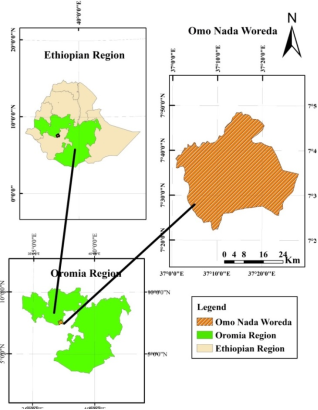
Figure 1. Map of the study Area.
Because of its elevation, Omo Nada, which is in the Jimma Zone of the Oromia Region, Ethiopia, has a tropical highland climate. Because of the highland altitude, the region experiences generally mild daytime temperatures and chilly nights, with an average yearly temperature of 15°C to 25°C. The two main rainy seasons—the short rains (Belg) from March to May and the big rainy season (Kiremt) from June to September—average 1,500 mm to 2,200 mm of rainfall annually.
2.3. Experimental Design and Treatments
Three replications of three irrigation levels (i.e., fifty, seventy-five, and one hundred percent) and three furrow irrigation systems (conventional, alternator, and fixed) will be used in the randomized full block design of the experiment. For the experiment, a suggested onion variety that is often grown in the research region was planted as a test crop. The plot measured 5 m in length and 3.14 m in width. Plants were separated by 0.1 m, and each band size was separated by 0.6 m. Plots and replications were separated by 1 m and 1.5 m, respectively. During transplanting, the suggested fertilizer rates of 242 kg/ha NPS and 150 kg/ha UREA were used .
Experimental procedure and management practice
To ensure proper germination and a good plant stand, the seeds were planted on a nursery seed bed field that had been prepared and well-watered. The beds were watered with a watering can and covered with dry grass mulch until they emerged. To harden the seedlings and lessen transplant shock, the water supply to the nursery seedbed was cut off one week before transplantation. To facilitate uprooting and avoid root damage, the seedlings were hydrated before transplanting.
The experimental plots were where the seedlings were moved. The Parshall flume was used to measure the amount of water applied during the furrow irrigation process. Using the CROPWAT program, irrigation scheduling was carried out according to the replenishment of soil water depletion. The FAO Penman-Monteith method was used to calculate crop water requirements using the CROPWAT tool. The gravimetric method of determining soil moisture content was used to track the water level of the soil. To determine the moisture content at the management-allowable depletion level and the moisture content at the field capacity level two days after irrigation, soil samples were gathered from well-irrigated plots immediately before irrigation. The site's standard tillage and agricultural practices for growing onions were adhered to. Every other agronomic procedure remained consistent and routine. For all the treatments, including pre-irrigation and one irrigation after germination.
2.4. Data Collected and Identified
1. Texture, Bulk density, Infiltration rate, FC, PWP, EC, CEC, OM, and PH),
2. Chemical properties of irrigation water (Boron, EC, and PH),
3. Date of irrigation (Irrigation Amount applied at every event,
4. Rainfall record, Soil moisture content before every irrigation event,
5. Daily weather variables (Rainfall, air temperature (Maximum and Minimum), Wind speed, RH, and sunshine hours),
6. Agronomic parameters (Sowing data, emergence, Plant height, number of leaves per plant, date of maturity, unmarketable Bulb yield, marketable Bulb yield, Bulb height, and Bulb Diameter).
2.5. Agronomic Data Collection
Relevant agronomic data were recorded during the experiment period. Five randomly selected plants from the central three rows per plot, excluding the border rows and border plants, were taken as a sample.
Plant height (cm) Five Onion plants were selected from the interior of three rows to avoid the border effect. The height of these five plants was measured from the ground surface to the tip of the plant using a ruler. The mean value of the five-plant height was recorded as the plant height of each plot.
Leaf number pre-plant refers to the mean number of leaves produced by sampled plants at the mid-stage. The number of leaves, all completely developed leaflets, was counted and recorded per plant. The sum of the total number of leaves of sampled plants was divided by the number of plants to get the mean number of leaves per plant.
Leaf length (cm) refers to the measured average length of a leaf by using a ruler in centimeters. The average leaf length was obtained by dividing the sum of measured leaf lengths of the five randomly selected plants at the maturity stage by the number of leaves.
Bulb height (cm) refers to the mean length of randomly selected five bulbs using a digital caliper in centimeters. Then, the average bulb height of five bulbs was recorded as bulb height.
Bulb diameter (cm) refers to the mean diameter of five samples of randomly selected plant bulbs from interior rows and measured at the widest point in the middle portion of the mature bulb using a digital caliper.
Marketable bulb yield: Marketable bulb (MC) yield was recorded as weight (kg ha-1) obtained from the central three rows of the experimental field.
Unmarketable bulb yield (UMC): Unmarketable bulbs recorded as weight (kg ha-1) were obtained from the central three rows of the experimental field.
Total bulb yield (kg ha-1) was recorded from the net plot area by weighing (kg ha-1) all bulbs taken from the central three rows of a plot that include marketable and unmarketable bulb weight.
Days to maturity: Days to maturity were the actual number of days from the day of transplanting to the time when 70% of plants’ foliage fell and when plants show neck fall in the field experiment.
2.6. Soil Sampling Analysis
Composite soil samples were collected from the experimental field at 20cm increments (0 – 20 cm, 20 – 40 cm, and 40 – 60 cm) up to 60 cm soil depth from the surface. The soil texture was analyzed using the hydrometer method. The soil bulk density was determined by taking undisturbed soil samples from the effective root zone at 20 cm intervals up to 60 cm using a core sampler having a volume capacity of 98.125 cm3. The soil and water chemical analysis includes soil pH, ECe, OC, and OM.
2.7. Determination of Crop Water Requirement
The CROPWAT program was used to calculate the crop water requirements of onions for the different growth phases based on the replenishment of soil water depletion. The CROPWAT software was fed monthly climate data from the study area meteorological station, soil physical characteristics of the irrigation scheme, including texture, field capacity, permanent wilting point, and available water capacity, as well as the soils' infiltration capacity. The crop type, data on growth stages, the times to maturity, the effective rooting depth, and the number of days till maturity are other inputs needed by the model.
The reference evapotranspiration (ETo) and onion crop coefficient (Kc), as provided by , are 0.5 for the initial stage, 0.5<Kc<1.15 for the crop developmental stage, 1.15 for the mid-season stage, and 0.6 for the late-season stage. This is necessary to calculate the amount of water needed (CWR) to make up for the amount of water lost through evapotranspiration (ETc). CROPWAT software was used to calculate the crop water need (ETc) based on crop coefficient (Kc) and ETo during the growth season.
ETc = ETo * Kc(1)
Where, ETc = actual evapotranspiration (mm/day), Kc = crop coefficient, and ETo = reference crop evapotranspiration (mm/day). The net irrigation requirement will be calculated using the CROPWAT software based on, . as follows:
IRn=ETc-Pe(2)
Where, IRn =Net irrigation requirement (mm), ETc in mm, and Pe = effective rainfall (mm), which is part of the rainfall that enters the soil and is made available for crop production. The effective rainfall (pe) will be estimated using the method given by .
Pe=0.6*P–10/3forPmonth<=70mmor
Pe=0.8*P–24/3forPmonth>70mm(3)
Where, Pe (mm) = effective rainfall and P (mm) = total rainfall. The gross irrigation requirements account for losses of water incurred during conveyance and application to the field. This is expressed in terms of efficiencies when calculating project gross irrigation requirements from net irrigation requirements, as shown below:
IRg=IRn/Ea(4)
where, IRg gross irrigation requirement (mm), Ea irrigation efficiency.
Application time (T) is the time required to refill the depleted soil moisture for each irrigation event
T=A*IRg6*q (5)
Where, T= Application time (min), A= Area to be irrigate (m2), IRg= gross irrigation requirement (cm) q= Discharge rate (l/s)
Total available water (TAW), stored in a unit volume of soil for the crop during the growing season, will be calculated as field capacity minus wilting point times the rooting depth of the crop.
TAW= (FC-PWP)*BD*DZ/100 ρw(6)
Where TAM=Total available Water (%), FC= Field capacity, PWP= Permanent wilting point, BD= Bulk density of the soil (gm cm-3), ρw=Density of water (gm cm-3) and DZ= maximum effective root zone depth (mm)
Bulk density (BD) is the mass of a soil in a unit volume for undisturbed soil conditions and is expressed on a dry weight basis of the soil as:
BD = Ms/ Vs (7)
where Ms = weight of oven-dry soil (gm), and Vs = volume of the same soil (cm3).
Readily available moisture (RAM) is the amount of water that crops can extract from the root zone without experiencing any water stress. The RAW will be calculated as
RAM=TAM*ρ(8)
Where ρ is the depletion fraction as defined by the crop coefficient (Kc) files.
2.8. Water Use Efficiency
Water use efficiency could be determined based on the ratio of yield of marketable yield to the crop depth of water and the irrigation depth of water used from germination to harvest. Hence, CWUE and IWUE, as expressed in Eq (9), were used to obtain the respective.
CWUE=YET and IWUE=YIrrigated water (9)
Where CWP is crop water productivity (kg/m3), Y crop yield (kg/ha), and ET is the seasonal crop water consumption by evapotranspiration (m3/ha).
2.9. Method of Data Analysis and Management
All agronomic and soil data that will be collected across locations will be properly managed using the EXCEL computer software. The collected data will be subjected to the ANOVA using the R software for statistical analysis. The differences among means were tested for significance at the 5% level according to .
3. Results and Discussion
3.1. Physical and Chemical Properties of Soil on the Experimental Site
The soil at the experimental station displayed a predominantly clay texture across the depths of 0-20 cm, 20-40 cm, and 40-60 cm, with average particle size distributions of 21.07% sand, 55.6% clay, and 23.33% silt (Table 1). The field capacity (FC) and permanent wilting point (PWP) values averaged 35.73% and 23.83%, respectively, with a total available water (TAW) content of 119 mm and bulk density (BD) of 1.15 g/cm3. (Table 1).
Table 1. Physical and chemical properties of soil on the experimental site.

soil Depth

particle size distribution%%

sand

clay

silt

texture

FC

PWP

TAW

BD

OC

OM

EC

PH

0-20

18.4

59.6

22

clay

35.5

21.4

139

1.07

1.95

3.36

6.47

7.03

20-40

26.4

49.6

24

clay

35.3

21.5

138

1.18

1.15

1.98

6.92

7.07

40-60

18.4

57.6

24

clay

34.8

21.8

130

1.2

1.13

1.95

6.98

7.08

average

21.07

55.6

23.33

clay

35.73

23.83

136

1.15

1.14

2.43

6.79

7.06

3.2. Crop Water Requirement and Irrigation Water Requirement of Onion
In 2023, 280.6 mm, 196.42 mm, and 140.3 mm of irrigation were applied for 100% ETc, 75% ETc, and 50% ETc, respectively, in conventional furrow irrigation (CFI). The comparable values for 100% ETc, 70% ETc, and 50% ETc for fixed furrow irrigation (FFI) and alternative furrow irrigation (AFI) were 70.13 mm, 98.18 mm, and 140.3 mm, respectively.
The applied irrigation quantities for 100% ETc, 70% ETc, and 50% ETc in 2024 stayed at 283.6 mm, 305.30 mm, and 198.52 mm, respectively. This also applies to CFI irrigation levels. Likewise, for AFI and FFI, the equivalent irrigation levels were 141.175 mm, 99.23 mm, and 70.88 mm for 100% ETc, 70% ETc, and 50% ETc, respectively.
Table 2. Crop Water Requirement and Irrigation Water Requirement of Onion 2023 year.

TRT

CFI100%ETc

CFI70%ETc

CFI50%ETc

AFI100%ETc

AFI70%ETc

AFI50%ETc

FFI100% ETc

FFI70% ETc

FFI50% ETc

IWR

280.6

196.4

140.3

140.3

98.2

70.1

140.3

98.2

70.1

CWR

378

264.6

189

189

132

94.5

189

132

94.5

Table 3. Crop Water Requirement and Irrigation Water Requirement of Onion 2024 year.

TRT

CFI100%ETc

CFI70%ETc

CFI50%ETc

AFI100%ETc

AFI70%ETc

AFI50%ETc

FFI100% ETc

FFI70% ETc

FFI50% ETc

IWR

283.6

198.5

141.8

141.8

99.3

70.9

141.8

131.2

93.7

CWR

374.7

262.3

187.4

187.4

131.2

93.7

187.4

131.2

93.7

Table 4. Depth Water Application on the Treatments (mm)year 2023.

Date

AFI/FFI100%ETc

AFI/FFI70%ETc

AFI/FFI50%ETc

CFI100%ETc

CFI70%ETc

CFI50%ETc

22-Feb

28.35

19.85

14.18

56.70

39.69

28.35

28-May

37.30

26.11

18.65

74.63

52.24

37.32

29-Apr

37.30

26.11

18.65

74.63

52.24

37.32

12-May

37.30

26.11

18.65

74.63

52.24

37.32

total

140.25

98.18

70.13

280.60

196.42

140.30

Table 5. Depth of Water Application on the Experimental Treatments (mm), year 2024.

Date

AFI/FFI100%ETc

AFI/FFI70%ETc

AFI/FFI50%ETc

CFI100%ETc

CFI70%ETc

CFI50%ETc

7-Jan

29.85

20.90

14.93

59.70

41.79

29.85

25-Feb

37.30

26.11

18.65

74.63

52.24

37.32

19-Mar

37.30

26.11

18.65

74.63

52.24

37.32

12-Apr

37.30

26.11

18.65

74.63

52.24

37.32

total

141.75

99.23

70.88

283.60

198.52

141.80

3.3. Crop Growth and Physiology Parameters
3.3.1. Plant Height
Plant heights varied significantly (P<0.05) depending on the application of various furrow irrigation methods and irrigation levels, according to analysis of variance (Table 6). With 100%ETc application, the highest plant height of 50.47 cm was measured from CFI; application-specific variations were notable. Among the deficit irrigations, the CF70%ETc application produced the tallest plants, and there was no discernible difference between it and the AFI100%ETc and FFI100%ETc applications.
The treatment that received more water had significantly taller plants than plots that received less water on the same sampling date. The shortest plant height, 40.32 cm, was recorded from deficit irrigation of 50%ETc application under FFI and does not significantly differ from FFI70%ETc and AFI50%ETc. According to similar trials, plant heights were lower with somewhat deficit irrigation during the crop growing season and higher with full irrigation (100%ETc), which is consistent with the current study's findings .
3.3.2. Number of Leaves Per Plant
Furrow irrigation techniques and irrigation levels did not affect the number of leaves per plant (Table 6). However, as water delivery levels declined, fewer leaves were produced per plant. With 100%ETc treatments, CFI reported the largest number of leaves per plant. The mean number of leaves for the treatment was higher when 70%ETc and 50%ETc were applied under CFI, 100%ETc and 70%ETc were applied under AFI, and 70%ETc was applied under FFI. With deficit irrigation of 50% ETc treatments, FFI produced the fewest leaves per plant, while FFI and AFI produced almost equal numbers of leaves per plant with 70% ETc applications. According to earlier research on crop water stress, this suggests that cutting irrigation below the ideal level can have a detrimental effect on plant growth .
3.3.3. Leaf Length (LL)
A significant (P<0.05) difference across treatments was revealed by analysis of variance, and the longest leaves (52 cm) were found under CFI with full irrigation. And had demonstrated no discernible variations between applications of CFI70%ETc and AFI100%ETc. Under FFI at 50% ET, the shortest leaves (36 cm) were seen, and there were no appreciable variations from CFI50%ETc, AFI50%ETc, AFI70%ETc, FFI70%ETc, and FFI100%ETc treatments. The decrease in leaf length under water stress conditions implies that water availability has a direct effect on leaf expansion. The plant's ability to photosynthesize may be diminished if water stress restricts cell growth, resulting in shorter leaves. Likewise, the CFI approach creates a more stable moisture environment, which encourages cell elongation and, consequently, longer leaves, as demonstrated by . The outcomes also support those of , who pointed out that CFI guarantees adequate water availability during the growth phase, which is necessary for the best possible elongation of leaf cells..
3.3.4. Leaf Width (LW)
Onion width was considerably (P<0.05) impacted by deficit irrigation levels and furrow irrigation techniques. Under CFI with 100% ETc, the leaf width was at its widest (7 cm), while there was no discernible difference with CFI70%ETc. While there was no discernible difference between AFI50%ETc and FFI at 50% ETc, the thinnest leaves (4.5 cm) were discovered with FFI. The greatest leaf width from deficit irrigation was CFI70%ETc, with no discernible difference from CFI50%ETc, AFI70%ETc, FFI70%ETAFI100%ETc, and FFI100%ETc. The notion that water availability is essential for leaf development is further supported by this decrease in leaf breadth during deficit irrigation. The findings of , who showed that regular irrigation promotes the lateral development of leaf cells, resulting in larger leaves, corroborate this conclusion. Additionally, because broader leaves are a sign of improved water status and nutrient uptake, discovered that they are frequently linked to higher irrigation levels. The results are in line with those of , who noted that as water availability directly affects the rate of photosynthesis and leaf expansion, the CFI method's capacity to maintain a constant supply of water is essential for the development of leaf width. The plant's capacity to absorb light may be diminished by narrower leaves, which could affect photosynthesis and general growth .
Table 6. ANOVA TABLE Crop Growth and Physiology Parameters.

FT x WL

PH (cm)

NLP (No)

LL (cm)

LW (cm)

CFIx100*ETC

50.47a

9.667a

43.43a

0.13a

CFIx75*ETC

47.8b

9ab

43.1ab

0.113ab

AFIx100*ETC

46.52bc

9ab

40.97abc

0.107bc

FFIx100*ETC

46.03bc

8.33bc

39.5bcd

0.1bc

CFIx50*ETC

44.17cd

8bc

38.73cd

0.1bc

AFIx75*ETC

43.1de

8bc

37.13d

0.097cd

FFIx75*ETC

42.58def

8bc

37.03d

0.097cd

AFIx50*ETC

41.5ef

7.67c

36.5d

0.083de

FFIx50*ETC

40.32f

7.333c

36.33d

0.07e

(LSD)P=0.05

1.49

0.70

2.19

0.009

Mean

44.99

8.38

39.19

0.10

C.V.

3.35

8.48

5.59

9.26

3.4. Yield and Yield Parameters
3.4.1. Bulb Diameter
While the smallest bulb diameter (5.5 cm) happened under FFI at 50% ETc, the maximum diameter (8.5 cm) was seen with CFI at full irrigation, and there was no discernible difference with CFI70%ETc, AFI100%ETc, and AFI100%ETc. The highest bulb diameter measured from deficit irrigation was AFI100%ETc, with no discernible difference from CFI70%ETc, FFI100%ETc, and AFI70%ETc. Proper nutrition and water translocation to the bulb are ensured by an adequate water supply, which supports bulb growth. This result is consistent with the study by , which showed that consistent and continuous water administration under CFI improves nutrient absorption and lowers the likelihood of water stress, resulting in bigger bulb diameters. Furthermore, research on garlic by corroborates that full irrigation (100% ETc) under conventional furrow methods consistently produces larger bulb diameters compared to deficit treatments. found that the CFI method's consistent moisture regime is essential for bulbous plants' ideal growth, which results in greater diameters. These results are corroborated by Singh et al.'s study from , which demonstrates that proper irrigation promotes the growth of larger bulbs by avoiding growth restrictions brought on by water constraint. However, because there is less photosynthetic buildup under water stress, bulbs may grow smaller ).
3.4.2. Bulb Width
The bulb diameter (BW) analysis of variance revealed a significant (P<0.05) difference between irrigation level and furrow irrigation techniques. When compared to AFI100%ETc, FFI100%ETc, and CFI70%ETc, there was no discernible difference in the production of the widest bulbs (6.5 cm) under CFI at 100% ETc. AFI50%ETc, FFI70%ETc, and CFI50%ETc did not significantly differ from one another; however, the narrowest bulbs (4 cm) were seen under FFI at 50% ETc. The maximum bulb width measured from deficiency AFI100%ETc was not significantly different from CFI100%ETc, CFI70, and FFI100%ETc. This is similar to findings, which showed that regular irrigation promotes the general growth of bulb tissues, resulting in broader bulbs. Furthermore, according to , a sufficient water supply via the CFI approach helps the bulb's cells divide and expand more effectively, which widens the bulb. These results are further supported by the study conducted by , which highlights the importance of water availability during the crucial growth stages to achieve greater bulb dimensions. The water supply affects bulb breadth just as it does bulb diameter, with inadequate irrigation resulting in slower bulb growth. Other research on the detrimental effects of water deficiency on bulb crops is in line with this decrease in bulb width under water stress conditions.
3.4.3. Bulb Weight
According to the analysis of variance, bulb weight is not significantly impacted by irrigation levels or furrow irrigation techniques. The lightest single bulbs (29 g) were produced under FFI at 50% ETc, with no significant differences in AFI50%ETc, FFI70%ETc, and CFI50%. The heaviest single bulbs (43 g) were found under CFI at full irrigation, with no significant differences with AFI100%ETc, AFI70%ETc, FFI100%ETc, and CFI70%ETc. This conclusion is in line with a study , which showed that a steady supply of water via CFI improves bulb growth overall, leading to heavier bulbs and more biomass buildup. Likewise, the study found that the final weight of the bulb depends critically on the amount of water available during the bulb formation stage. Additionally, discovered that the CFI method's capacity to sustain ideal soil moisture levels is essential for maximizing bulb weight since it facilitates the ongoing intake of water and nutrients. This outcome emphasizes how crucial proper irrigation is to reaching the ideal bulb weight, which is a crucial component of marketability. Lighter bulbs are probably the result of reduced water availability, which restricts the transfer of carbohydrates to the bulb.
Table 7. ANOVA Table for Yield and Yield Parameters.

FTxWL

BD

BW

WSB

CFIx100*ETC

48.98a

38.05a

43.03a

AFIx100*ETC

48.45a

36.9ab

41.53ab

FFIx100*ETC

47.13ab

35.867abc

41.03ab

CFIx75*ETC

45.75abc

35.167bc

39.2abc

AFIx75*ETC

44.3bcd

35.033bc

36.03abcd

CFIx50*ETC

43.42bcd

34.233c

33.3bcd

AFIx50*ETC

43.067cd

33.57c

33.067bcd

FFIx75*ETC

41d

33.47c

31.117cd

FFIx50*ETC

40.63d

33.33c

29.2d

(LSD)P=0.05

2.31

1.5

5.61

(LSD) P=0.01

3.18

2.057

7.73

C.V.

5.17

4.26

15.42

3.4.4. Marketable Bulb Yields (MBY)
The marketable bulb yield (MBY) analysis of variance revealed a significant (P<0.05) difference between irrigation level and furrow irrigation techniques. The highest marketable bulb yield (9.3 t/ha) was obtained from CFI at full irrigation, with no significant difference from CFI70%ETc and AFI100%ETc. The lowest marketable bulb yield (5.3 t/ha) was obtained from FFI at 50% ETc, with no significant difference from AFI50%ETc and FFI70%ETc. The highest marketable bulb yield from deficit irrigation was AFI100%ETc, with no significant difference from CFI70%ETc and FFI100%ETc. This result is consistent with the findings of , who reported that CFI at full irrigation provides the necessary water for optimal bulb development, leading to higher marketable yields. Similarly, found that maintaining adequate soil moisture through CFI is critical for achieving high marketable yields in onion crops. The study further supports these results, emphasizing that water stress during the bulb formation stage can significantly reduce marketable yield. The lower marketable yield under deficit irrigation and FFI can be attributed to the reduced water availability, which limits bulb growth and increases the proportion of non-marketable bulbs. This aligns with research by , who noted that water stress adversely affects bulb size and quality, thereby reducing marketable yield. The findings underscore the importance of selecting appropriate irrigation methods and levels to maximize marketable yield in onion production.
3.4.5. Unmarketable Bulb Yields (UMBY)
The analysis of variance for unmarketable bulb yield (UMBY) showed a significant (P<0.05) difference among irrigation levels and furrow irrigation methods. The highest unmarketable bulb yield (3.5 t/ha) was recorded under FFI at 50% ETc, with no significant difference from AFI50%ETc and FFI70%ETc. The lowest unmarketable bulb yield (1.2 t/ha) was obtained from CFI at full irrigation, with no significant difference from CFI70%ETc and AFI100%ETc. The highest unmarketable bulb yield from deficit irrigation was AFI50%ETc, with no significant difference from FFI50%ETc and FFI70%ETc. This result is in agreement with the findings of , who observed that deficit irrigation increases the proportion of unmarketable bulbs due to water stress-induced growth limitations. reported that inadequate water supply under FFI and deficit irrigation leads to a higher incidence of small and malformed bulbs, contributing to increased unmarketable yield. The study also supports these results, highlighting that water stress during critical growth stages can result in a greater number of unmarketable bulbs. The increase in unmarketable yield under water stress conditions is likely due to reduced bulb size and quality, as noted by . These findings highlight the negative impact of water stress on bulb quality and emphasize the need for optimal irrigation management to minimize unmarketable yield.
3.4.6. Total Bulb Yield (TBY)
The analysis of variance for total bulb yield (TBY) indicated a significant (P<0.05) difference among irrigation levels and furrow irrigation methods. The highest total bulb yield (10.5 t/ha) was achieved under CFI at full irrigation, with no significant difference from CFI70%ETc and AFI100%ETc. The lowest total bulb yield (8.7 t/ha) was recorded under FFI at 50% ETc, with no significant difference from AFI50%ETc and FFI70%ETc. The highest total bulb yield from deficit irrigation was AFI100%ETc, with no significant difference from CFI70%ETc and FFI100%ETc. This result corroborates the findings of , who demonstrated that CFI at full irrigation supports the highest total bulb yield by ensuring adequate water supply throughout the growth cycle. Similarly. found that total bulb yield is maximized under CFI due to its ability to maintain consistent soil moisture levels. The study by further confirms that water stress under deficit irrigation and FFI reduces total yield by limiting bulb development. The reduction in total yield under water stress conditions is consistent with research by , who reported that insufficient irrigation negatively impacts overall bulb production. These results underscore the importance of adequate irrigation for achieving high total bulb yields in onion cultivation).
Table 8. ANOVA Table for unmarketable, marketable, and total bulb yield.

FTxWL

UMBY (ton/ha

MBY (ton/ha

TBY (ton/ha

CFIx100*ETC

1.28f

28.67a

29.96a

CFIx75*ETC

1.36e

23.18b

24.54b

AFIx100*ETC

1.57d

21.83b

23.40b

FFIx100*ETC

2.3b

17.18c

19.48bc

AFIx75*ETC

1.66c

16.75cd

18.4cd

CFIx50*ETC

1.41e

16.65.25cd

17.99cd

FFIx75*ETC

2.38a

13.23d

15.63cd

AFIx50*ETC

1.74c

13.08d

14.81cd

FFIx50*ETC

2.45a

13.0d

14.45d

CD (LSD) 5%

0.04

0.90

7.60

CD (LSD) 1%

0.06

1.24

10.47

C.V.

2.49

12.44

13.31

3.5. Water Use Efficiency
3.5.1. Irrigation Water Use Efficiency (IWUE)
Furrow irrigation systems and deficit irrigation levels had a substantial (P<0.05) impact on IWUE, according to the analysis of variance. With the 50%ETc irrigation application, the highest IWUE of 74.367 kg mm⁻¹ was recorded under AFI practice. There was no significant difference from the FFI50%ETc, AFI70%ETc, and AFI*100%ETc method, and the lowest IWUE (40 kg/m3) was recorded under CFI at full irrigation. There was also no significant difference between CFI50%ETc, CFI70%ETc, FFI100%ETc, and FFI70%ETc. The AFI100%ETc application produced the second-highest onion production of 8.7 tons/ha among those deficit irrigations and conserved 50% of the necessary irrigation water. This outcome is consistent with findings , which showed that alternate furrow irrigation increases IWUE by using less water without appreciably lowering production. Similar findings were reported by for garlic, where AFI at 100% ETc resulted in the highest irrigation water use efficiency, demonstrating the broad applicability of this technique for Allium crops in water-scarce regions. According. , the AFI approach also improves water use efficiency by optimizing water application, which lowers evaporation and runoff losses. These results are further supported by a study by , which demonstrates that the AFI approach improves water distribution and uptake efficiency by concentrating water application in alternating furrows, increasing IWUE.
3.5.2. Crop Water Use Efficiency (CWUE)
Furrow irrigation systems and deficit irrigation levels had a significant (P<0.05) impact on CWUE, according to the analysis of variance. The highest CWUE (55.73 kg/m3) was recorded under AFI at 50% ETc, with no significant difference from AFI 70%ETc, AFI100%ETc, FFI70%ETc, and FFI50%ETc. The lowest CWUE (30.4 kg/m3) was found under CFI at full irrigation. This finding implies that AFI may be a more successful tactic for optimizing water productivity in situations where the water supply is constrained. Other research supports this conclusion by demonstrating that deficit irrigation can increase CWUE without appreciably lowering yield . Additional. noted that the AFI approach increases CWUE by encouraging deeper root growth and increased water uptake, both of which enhance crop-level water use efficiency. Furthermore, the study discovered that the AFI method's capacity to sustain greater soil moisture levels in alternating furrows improves the crop's overall water use efficiency, leading to improved CWUE.
Table 9. ANOVA Table for Water Use Efficiency.

FTxWL

IWUE

CWUE

AFIx50*ETC

74.37a

55.73a

FFIx50*ETC

73.97a

55.43a

AFIx70*ETC

67.067a

50.3a

AFIx100*ETC

61.93ab

46.4ab

FFIx70*ETC

53.733bc

40.3bc

FFIx100*ETC

48.6c

36.47c

CFIx50*ETC

47.43c

35.57c

CFIx70*ETC

46.77c

35.1c

CFIx100*ETC

40.57c

30.4c

Mean

57.16

42.86

(LSD) P=0.05

7.60

5.72

C.V.

13.31

13.35

4. Conclusion
The study comes to the conclusion that AFI100% ETc is a very successful irrigation technique for optimizing water use efficiency and guaranteeing significant yields of onion bulbs. In terms of yield, the approach is not substantially different from CFI70% ETc and performed significantly better than other irrigation schemes, especially when water was scarce. This demonstrates how AFI100% ETc may be used as a sustainable substitute for conventional irrigation methods, providing a balance between high productivity and water saving. The results highlight how important it is to implement such effective irrigation methods to solve the problems associated with water scarcity in agriculture.
5. Recommendation
To maximize water use efficiency without sacrificing crop output, farmers in water-scarce regions are advised to implement the AFI100% ETc irrigation system. To maintain sustainable crop production, this strategy should be incorporated into agricultural practices, especially in regions with water constraints. To improve its use in diverse agricultural contexts, more studies should examine the long-term effects of AFI100% ETc on crop quality and soil health. Furthermore, governments ought to think about encouraging the use of AFI100% ETc by means of educational and assistance initiatives meant to improve agricultural water management techniques.
Abbreviations

AFI

Alternative Furrow Irrigation

FFI

Fixed Furrow Irrigation

CFI

Conventional Furrow Irrigation

ETc

Crop Evapotranspiration

IWUE

Irrigation Water Use Efficiency

CWUE

Crop Water Use Efficiency

Author Contributions
Abu Dedo Ilmi: Conceptualization, Data curation, Formal Analysis, Funding acquisition, Investigation, Methodology, Project administration, Resources, Software, Supervision, Validation, Visualization, Writing – original draft, Writing – review & editing
Roba Adugna Maru: Conceptualization, Data curation, Investigation, Methodology, Writing – original draft
Conflicts of Interest
The authors declare no conflicts of interest.
References
[1] Rajwade, V. B., Banafar, R. N. S., & Pathak, A. C. (2000). Growth analysis of potato about biodynamic package and organic manures with chemical fertilizers. Journal of the Indian Potato Association, 27(1-2), 55–58.
[2] Innocent, N., & Science, A. (2014). Onion production in tropical Africa: a review. Journal of Horticulture and Forestry, 6(4), 35-42.
[3] Nigussie, A., et al. (2015). Onion production for income generation in small-scale irrigation users' agropastoral households of Ethiopia.
[4] English, M. J. (1990). Deficit irrigation. I: Analytical framework. Journal of Irrigation and Drainage Engineering, 116(3), 399-412.
[5] Karda, B., Miglani, S., & Sarangal, P. (1999). Water use efficiency of deficit irrigation about soil moisture and crop growth. Field Crops Research, 63(1), 1-10.
[6] Karda, B. (2000). Deficit irrigation and water use efficiency in arid regions. Agricultural Water Management, 45(2), 107-121.
[7] Karam, F., Breidy, J., Stephan, C., & Rouphael, Y. (2005). Evapotranspiration, yield, and water use efficiency of drip irrigated corn in the Bekaa Valley of Lebanon. Agricultural Water Management, 72(3), 237-249.
[8] Kirnak, H., Kaya, C., Tas, I., & Higgs, D. (2002). The influence of water deficit on vegetative growth, physiology, fruit yield, and quality in eggplants. Bulgarian Journal of Plant Physiology, 28(1-2), 34-46.
[9] Bekele, S., & Tilehun, K. (2007). Regulated deficit irrigation scheduling of onion in a semiarid region of Ethiopia. Agricultural water management, 89(1-2), 148-152.
[10] Nigatu, T., Sharma, J. J., & Tefera, T. (2010). Deficit irrigation and planting density of onion (Allium cepa L.) in a semiarid region of Ethiopia. Journal of Horticulture and Forestry, 2(8), 154-162.
[11] FAO (2002). The state of food and agriculture 2002: The role of irrigation in food security. Food and Agriculture Organization of the United Nations, Rome.
[12] Zhang, H., & Oweis, T. (1999). Water-yield relations and optimal irrigation scheduling of wheat in the Mediterranean region. Agricultural Water Management, 38(3), 195-211.
[13] Getachew, T., Yilma, T., & Asefa, M. (2011). Onion production for income generation in small-scale irrigation users in agropastoral households of Ethiopia. Agricultural Systems, 104(7), 493-501.
[14] Allen, R. G., Pereira, L. S., Raes, D., & Smith, M. (1998). Crop evapotranspiration: Guidelines for computing crop water requirements. FAO Irrigation and Drainage Paper No. 56. Food and Agriculture Organization of the United Nations (FAO), Rome, Italy.
[15] Waller, R. A., & Duncan, D. B. (1969). A Bayes rule for the symmetric multiple comparisons problem. Journal of the American Statistical Association, 64(325), 1484-1503.
[16] Gebre, H., Mekonnen, W., & Teshale, A. (2017). Effects of different irrigation regimes on the yield and quality of onion in a semiarid area. Ethiopian Journal of Agricultural Sciences, 25(1), 89-100.
[17] Teshome, G., & Mekuria, W. (2019). Regulated deficit irrigation scheduling of onion in a semiarid region of Ethiopia. Agricultural Water Management, 89(1-2), 148-152.
[18] Alemayehu, T., Teshome, M., & Admasu, T. (2020). Impact of deficit irrigation on yield and water productivity of onion (Allium cepa L.) in the semiarid region of Ethiopia. Journal of Agricultural Science and Technology, 16, 1291-1301.
[19] Girma, H., Gebrehiwot, M., & Desalegn, A. (2019). Effect of different irrigation regimes on growth and yield of onion (Allium cepa L.) under drip irrigation. Ethiopian Journal of Agricultural Sciences, 25(1), 89-100.
[20] Meena, R., Singh, P., & Verma, S. (2023). Improving irrigation strategies for onion yield under water-limited conditions. Journal of Irrigation Science, 42(2), 90–105.
[21] Kumar, A., Patel, N., & Sharma, R. (2023). Impact of irrigation techniques on bulb crop performance and nutrient uptake. Journal of Agricultural Water Management, 150, 175-190.
[22] Chaves, M. M., Pereira, J. S., Maroco, J., Rodrigues, M. L., Ricardo, C. P. P., Osório, M. L., & Pinheiro, C. (2002). How plants cope with water stress in the field: Photosynthesis and growth. Annals of Botany, 89(7), 907-916.
[23] Shahrokhnia, M. H., & Sepaskhah, A. R. (2013). Single and dual crop coefficients and crop water requirement for wheat and maize in a semi-arid region. Agricultural Water Management, 120, 10-18.
[24] Hadi, M., & Hussain, A. (2023). Impact of irrigation strategies on leaf morphology and crop performance under water-limited conditions. Journal of Irrigation Science, 41(1), 45-58.
[25] Rana, R., Kumar, N., & Singh, V. (2023). Effect of water management practices on leaf development and yield in onion crops. Agricultural Water Management, 130, 125-140.
[26] Sharma, R., & Patel, N. (2023). Irrigation techniques and their influence on crop morphology and yield stability. Journal of Agronomy and Crop Science, 209(3), 314-329.
[27] Tardieu, F., Granier, C., & Muller, B. (2006). Water deficit and growth. Coordination of cell proliferation and expansion in response to changes in plant water status. Planta, 223(4), 1-11.
[28] Bhatt, R., Singh, K., & Chauhan, H. (2023). Effect of irrigation regimes on the yield and quality of bulb crops in arid regions. Agricultural Sciences Journal, 27(2), 89-104.
[29] Singh, P., Kumar, S., & Yadav, R. (2022). Influence of water management practices on bulb yield and quality parameters. International Journal of Agronomy, 2022, 1-12.
[30] Ferreira, T. C., Gonçalves, D. A., & Silva, M. A. (2015). Water stress effects on the growth and yield of bulb crops. Journal of Crop Production, 18(3), 245-260.
[31] Ali, M., Hussain, F., & Khan, S. (2023). Effect of irrigation strategies on yield and marketability of onion bulbs. Agricultural Water Management, 160, 100-115.
[32] Geerts, S., & Raes, D. (2009). Deficit irrigation as an on-farm strategy to maximize crop water productivity in dry areas. Agricultural Water Management, 96(9), 1275-1284.
[33] Verma, S., Singh, A., & Yadav, P. (2023). Critical irrigation periods and their impact on bulb yield and quality. International Journal of Agronomy and Crop Science, 32(1), 85-100.
[34] Ahmadi, S. H., & Bahrani, M. J. (2009). Yield and water use efficiency of forage corn as affected by deficit irrigation. Agricultural Water Management, 96(11), 1615-1620.
[35] Sadras, V. O. (2009). Does partial root-zone drying improve irrigation water productivity in the field? A meta-analysis. Irrigation Science, 27(3), 183-190.
[36] Zhang, H., Oweis, T. Y., & Paredes, P. (2013). Water use efficiency and yield of deficit-irrigated crops in a semi-arid environment. Agricultural Water Management, 117, 1-1.
[37] Ilmi, A. D., Kebede, A., & Hordofa, T. (2025). Effect of water application level on garlic (Allium sativum L.) under different furrow irrigation systems, in Tiyo District, Central Ethiopia. Mediterranean Journal of Basic and Applied Sciences, 9(1), 77–99.
[38] Ilmi, A. D. (2025). The role of deficit irrigation in enhancing water use efficiency in garlic (Allium sativum) production, Central Ethiopia's Tiyo District. International Interdisciplinary Journal of Scientific Research, 9(3), 35–45.
[39] Ilmi, A. D. (2025). Optimizing garlic yield through furrow irrigation systems and deficit irrigation in Central Ethiopia, Tiyo District. Journal of Water Resources and Ocean Science, 14(3), 60–69.
Cite This Article
  • APA Style

    Ilmi, A. D., Maru, R. A. (2025). Evaluation of Alternative, Fixed, and Conventional Furrow Irrigation on the Yield of Onion, Jimma Zone South Western Oromia. Science Futures, 1(1), 115-126. https://doi.org/10.11648/j.scif.20250101.23

    Copy | Download

    ACS Style

    Ilmi, A. D.; Maru, R. A. Evaluation of Alternative, Fixed, and Conventional Furrow Irrigation on the Yield of Onion, Jimma Zone South Western Oromia. Sci. Futures 2025, 1(1), 115-126. doi: 10.11648/j.scif.20250101.23

    Copy | Download

    AMA Style

    Ilmi AD, Maru RA. Evaluation of Alternative, Fixed, and Conventional Furrow Irrigation on the Yield of Onion, Jimma Zone South Western Oromia. Sci Futures. 2025;1(1):115-126. doi: 10.11648/j.scif.20250101.23

    Copy | Download

  • @article{10.11648/j.scif.20250101.23,
      author = {Abu Dedo Ilmi and Roba Adugna Maru},
      title = {Evaluation of Alternative, Fixed, and Conventional Furrow Irrigation on the Yield of Onion, Jimma Zone South Western Oromia},
      journal = {Science Futures},
      volume = {1},
      number = {1},
      pages = {115-126},
      doi = {10.11648/j.scif.20250101.23},
      url = {https://doi.org/10.11648/j.scif.20250101.23},
      eprint = {https://article.sciencepublishinggroup.com/pdf/10.11648.j.scif.20250101.23},
      abstract = {Efficient use of limited irrigation water is essential for sustaining crop productivity in water-scarce regions of Ethiopia. Onion (Allium cepa L.), a high-value horticultural crop, is widely cultivated under small-scale irrigation systems, yet its production is often constrained by inefficient water management. This study evaluated the effects of three furrow irrigation methods — Alternative Furrow Irrigation (AFI), Fixed Furrow Irrigation (FFI), and Conventional Furrow Irrigation (CFI) — combined with three irrigation levels (50%, 70%, and 100% ETc) on the growth, yield, and water use efficiency of onion in the Jimma Zone of southwestern Oromia. A randomized complete block design with three replications was used over two cropping seasons. The results demonstrated that irrigation method and irrigation level had significant impacts on key agronomic traits, bulb yield components, and water use efficiencies. The highest marketable bulb yields were obtained from CFI100% ETc (9.3 t/ha) and CFI70% ETc, followed closely by AFI100% ETc (8.7 t/ha), which produced statistically comparable yields while using 50% less irrigation water. Deficit irrigation under AFI showed remarkable water-saving benefits without substantial yield penalties. AFI50% ETc and AFI70% ETc produced moderate yields but achieved the highest irrigation water use efficiency (IWUE) and crop water use efficiency (CWUE), reaching 74.37 kg/mm and 55.73 kg/m3, respectively. In contrast, FFI50% ETc produced the lowest yield performance due to prolonged water stress in non-irrigated furrows. Overall, AFI100% ETc provided the best balance between high yield and efficient water use, demonstrating its suitability for water-limited environments. The findings suggest that AFI, particularly at full irrigation, can serve as a sustainable alternative to conventional furrow irrigation, helping farmers optimize water productivity without compromising crop output. The study recommends wider adoption of AFI100% ETc in regions facing irrigation water shortages.},
     year = {2025}
    }
    

    Copy | Download

  • TY  - JOUR
    T1  - Evaluation of Alternative, Fixed, and Conventional Furrow Irrigation on the Yield of Onion, Jimma Zone South Western Oromia
    AU  - Abu Dedo Ilmi
    AU  - Roba Adugna Maru
    Y1  - 2025/12/19
    PY  - 2025
    N1  - https://doi.org/10.11648/j.scif.20250101.23
    DO  - 10.11648/j.scif.20250101.23
    T2  - Science Futures
    JF  - Science Futures
    JO  - Science Futures
    SP  - 115
    EP  - 126
    PB  - Science Publishing Group
    SN  - 3070-6289
    UR  - https://doi.org/10.11648/j.scif.20250101.23
    AB  - Efficient use of limited irrigation water is essential for sustaining crop productivity in water-scarce regions of Ethiopia. Onion (Allium cepa L.), a high-value horticultural crop, is widely cultivated under small-scale irrigation systems, yet its production is often constrained by inefficient water management. This study evaluated the effects of three furrow irrigation methods — Alternative Furrow Irrigation (AFI), Fixed Furrow Irrigation (FFI), and Conventional Furrow Irrigation (CFI) — combined with three irrigation levels (50%, 70%, and 100% ETc) on the growth, yield, and water use efficiency of onion in the Jimma Zone of southwestern Oromia. A randomized complete block design with three replications was used over two cropping seasons. The results demonstrated that irrigation method and irrigation level had significant impacts on key agronomic traits, bulb yield components, and water use efficiencies. The highest marketable bulb yields were obtained from CFI100% ETc (9.3 t/ha) and CFI70% ETc, followed closely by AFI100% ETc (8.7 t/ha), which produced statistically comparable yields while using 50% less irrigation water. Deficit irrigation under AFI showed remarkable water-saving benefits without substantial yield penalties. AFI50% ETc and AFI70% ETc produced moderate yields but achieved the highest irrigation water use efficiency (IWUE) and crop water use efficiency (CWUE), reaching 74.37 kg/mm and 55.73 kg/m3, respectively. In contrast, FFI50% ETc produced the lowest yield performance due to prolonged water stress in non-irrigated furrows. Overall, AFI100% ETc provided the best balance between high yield and efficient water use, demonstrating its suitability for water-limited environments. The findings suggest that AFI, particularly at full irrigation, can serve as a sustainable alternative to conventional furrow irrigation, helping farmers optimize water productivity without compromising crop output. The study recommends wider adoption of AFI100% ETc in regions facing irrigation water shortages.
    VL  - 1
    IS  - 1
    ER  - 

    Copy | Download

Author Information
  • Abstract
  • Keywords
  • Document Sections

    1. 1. Introduction
    2. 2. Materials and Methods
    3. 3. Results and Discussion
    4. 4. Conclusion
    5. 5. Recommendation
    Show Full Outline
  • Abbreviations
  • Author Contributions
  • Conflicts of Interest
  • References
  • Cite This Article
  • Author Information