Research Article | | Peer-Reviewed

Determinants for Retirement Savings of Employees in Tertiary Institutions of Zimbabwe

Received: 29 October 2025     Accepted: 7 November 2025     Published: 9 December 2025
Views:       Downloads:
Abstract

Retirement savings are critical role for ensuring financial security of employees in the post-retirement phase, and a variety of factors significantly influence employees` ability to make retirement savings. The existence of retirement savings is important when planning for retirement mainly in the face of increased life expectancy, high cost of living, and the increased retirement age of employees in Zimbabwe. This research sought to examine the determining factors of retirement savings among employees in tertiary institutions with focus on one institution in Harare. The determinants that affect workers` retirement savings are identical across all other tertiary institutions hence the findings from the study would be a representative of other tertiary institutions across Zimbabwe. The study adopted a positivist paradigm and was a case study research where a sample of sixty respondents out of an accessible population of six-hundred staff establishment. The population was stratified into lecturing and non-lecturing staff. Simple random sampling was employed to come up with a sample size of sixty (60) respondents. Structured questionnaires and interview guides were used for collection of data. The study established that retirement savings were affected by age, marital status, gender, family size, family expenditure, level of education, financial literacy levels, interest rate, income level, exchange rate, and inflation rate. The study recommended that employees should attend financial literacy trainings together with savings and investment conferences so as to acquaint themselves with the general savings and investment management process that they could use. Such trainings would expose employees to various financial products such as shares, term deposits, unit trusts, cash savings, gold coins, investment in livestock, properties, diversified asset portfolio, fixed savings accounts, income generating projects, and other small business entrepreneurial ventures and start-ups. The management of tertiary institutions were recommended to positively influence employees to engage in retirement savings by funding employees to attend financial literacy and investment management training such that they would acquire the necessary knowledge to make savings and investments for post-retirement. Furthermore, institutions were recommended to hold quarterly and semi-annual seminars and conferences on retirement planning and retirement savings and make attendance by employees’ mandatory such that their attitude on retirement savings increases.

Published in Science Futures (Volume 1, Issue 1)
DOI 10.11648/j.scif.20250101.13
Page(s) 21-27
Creative Commons

This is an Open Access article, distributed under the terms of the Creative Commons Attribution 4.0 International License (http://creativecommons.org/licenses/by/4.0/), which permits unrestricted use, distribution and reproduction in any medium or format, provided the original work is properly cited.

Copyright

Copyright © The Author(s), 2025. Published by Science Publishing Group

Keywords

Retirement, Savings, Socio-demographic, Economic, Investment, Financial Literacy

1. Introduction
The well-being of employees in many Sub-Sahara African (SSA) countries especially in the post-retirement phase has been very low and a handful of retirees live miserably despite having been on payroll . The pension payouts are very low in many African countries thereby failing to sustain the post-retirement financial needs of many retirees . The study sought to examine the real determinants which affect retirement savings of employees because some employees partake in retirement savings whilst others do not despite working for the same employer and under the same economic challenges bedeviling Zimbabwe. Retirement savings are critical for ensuring financial security of employees in the post-retirement phase, and a variety of factors significantly influence employees` ability to make retirement savings . The existence of savings for retirement is important when planning for retirement particularly in the face of increased life expectancy, rising cost of living, and the increased retirement age of employees in Zimbabwe.
1.1. Problem Statement
Despite the existence of pension schemes for government employees to cushion retirees in the post-retirement phase, the level of financial well-being of employees remains very low as the pension payouts are very low to sustain retirees . This calls for the need for employees to supplement the employer`s pension fund through personal retirement savings. However, there are some notable disparities between employees` involvement in retirement savings as some employees partake in retirement savings whilst others do not despite working for the same employer, in the same salary scale, and living under same economic conditions. These discrepancies have triggered the researchers to examine the determinants of retirement savings among employees in tertiary institutions in Zimbabwe.
1.2. Research Objectives
The research was based on the following;
1) To identify the socio-demographic determining factors that affect retirement savings of employees in tertiary institutions of Zimbabwe.
2) To examine the economic determinants which affect retirement savings of employees in tertiary institutions of Zimbabwe.
3) To suggest interventions that would amplify the culture of savings on employees in tertiary institutions of Zimbabwe.
2. Theoretical Review
Retirement savings are critical for effective retirement planning and enables employees to have a sound post-retirement financial well-being . There are various theories that are useful in the study of retirement savings from the life cycle hypothesis, permanent income hypothesis, career construction theory, theory of continuity, and the overlapping generations model .
Retirement planning is a vital aspect of financial wellbeing that ensures individuals maintain a decent quality of life after their formal working years . In Zimbabwe, retirement planning has become increasingly important due to the country`s volatile economic history, inflationary environment and a fragile social protection system . Many Zimbabwean employees face uncertain retirement futures owing to both structural and personal factors that hinder adequate preparation. The retirement landscape in Zimbabwe has evolved through various stages notably influenced by the collapse of the Zimbabwean dollar in year 2008-2009., which rendered many pension funds worthless . The National Society Security Authority (NSSA) has attempted to provide minimum retirement security for workers, but its coverage is limited serving only around 24% of the total workforce, with informal sector employees largely excluded . Several researchers have highlighted the key determinants of retirement planning in Zimbabwe including low financial literacy distrust in pension schemes, socio-cultural beliefs, weak employer pension systems and high unemployment among others as explained below;
Income level and type of employment
Income is a fundamental determinant in retirement planning and employees with higher or more stable income have a better capacity to save and invest towards retirement . The NSSA Pension Reports of 2023 specifies that Zimbabwe`s formal sector includes civil servants, bank workers and professionals with regular salaries while the informal sector consists of vendors, artisans and self-employed individuals. Informal workers often lack pension schemes, making retirement planning difficult whilst a government employee may contribute to the Public Service Pension Scheme monthly yet a street vendor may rely on savings or property. The disparity in income levels significantly affects the planning approach, investment options and retirement age .
Employment stability
Employment stability affects the predictability of income which in turn impacts the consistency of savings for retirement. In contexts of unstable employment or irregular income, savings for retirement can be challenging to maintain consistently . This unpredictability can lead to difficulties in planning for retirement effectively. For example; irregular income due to unstable employment affects the consistency of retirement savings and employment stability is crucial for consistent retirement planning .
Economic instability and currency volatility
Zimbabwe’s high inflation rate and economic volatility pose major challenges to retirement planning as retirement savings can lose value rapidly in an unstable economic environment. For example, someone who saved $10 000 in a local back in year 2007 lost its purchasing power significantly during hyperinflation. Employees are now cautious, seeking stable often foreign-denominated investments. This uncertainty forces individually to diversify their savings into USD accounts, real estate or even foreign pension funds if accessible. Inflation erodes confidence in long term savings, making financial planning a more urgent and complex process. Zimbabwe’s long history of hyperinflation (peaking at 79.6 billion percent in year 2008) and currency changes (e.g. from ZWD to USD to bond notes and ZWL) has severely eroded trust in formal retirement savings . For instance; pensioners who contributed to retirement schemes in the early 2000s found their pensions wiped out, leading to mass disillusionment. As a result, many employees prefer tangible assets like livestock or housing over pension schemes. Pensioners now receive less than US$20 monthly, a figure not even enough to cover basic food costs.
National pensions systems and policies
The availability and structure of national pension systems greatly affect retirement planning. In Zimbabwe the National Social Security Authority (NSSA) runs a compulsory pension scheme for formal workers. However, the payouts are often considered insufficient due to inflation and currency volatility. For example, retirees who contributed in Zimbabwean dollars before 2009 dollarization found their pensions severely devalued. Employees now tend to seek complementary retirement plans or property investments. Policy clarity, transparency and reforms in NSSA impact public trust, influencing how workers prepare for retirement beyond the statutory contributions. According to NSSA report of 2020 in pension schemes report, pension schemes play a vital role in retirement income security. Zimbabwe’s pension systems are fragmented and under-regulated, and over 470 pension funds are dormant due to mismanagement or company closures. Poor government schemes, discouraging both employers and employees from participation, whilst corruption and fund mismanagement have led to underfunded pensions and delayed payments .
Retirement age
Retirement age determines the timeline for retirement planning and impacts the amount of savings needed for retirement. Earlier retirement ages require more aggressive planning and savings strategies to ensure financial security in retirement. The choice of retirement age is a critical factor in planning for retirement. For example; earlier retirement impacts the savings needed for post-employment life. According to ZIMSTAT (2020) in labor force report, retirement age affects planning and savings needs. The retirement age in Zimbabwe is typically 60 to 65 years for many formal sector employees. This age impacts planning and savings needed for retirement.
Low financial literacy and education
Many Zimbabweans lack the knowledge required to assess pension options, save systematically or invest wisely. A survey by the Reserve Bank of Zimbabwe (RBZ) in 2020 found that less than 30% of adults understand how inflation affects savings. According to Kamakia, et al. (2017), financially illiterate employees may not differentiate between a defined benefit and a defined contribution scheme, impacting their planning outcomes . Many Zimbabweans lack financial literacy, making it difficult to plan effectively for retirement. Concepts like compound interest, investment diversification or annuity plans are not widely understood and some employees assume NSSA alone is sufficient unaware of the need for personal investments. Financial institutions and insurance companies like First Mutual or Old Mutual Zimbabwe have started offering educational workshops but their reach is still limited. Access to certified financial planners is mostly restricted to urban and upper-income employees and a well-informed individual is better equipped to plan for a secure retirement .
Family structure and cultural expectations
In Zimbabwean culture, family ties and social responsibilities influence retirement decisions as many employees expect to be supported by children after retirement, reducing their urgency to save. However, changing social dynamics such as migration or economic hardship means children may not be able or willing to offer support. Additionally, retirees may still be responsible for dependents such as grandchildren orphaned by HIV / AIDS. This intergenerational burden complicates retirement planning, forcing employees to delay retirement or seek passive income sources like small businesses or property rentals.
Personal attitudes towards savings and risk
Some individuals procrastinate retirement planning due to fatalism, lack of discipline or overconfidence in future income whilst others take excessive risks or invest in scams due to desperation or lack of guidance as many pensioners lost savings in the Ponzi scheme .
Employment benefits and employer contributions
Employer-provided retirement benefits such as gratuities or pensions contributions are a critical incentive for employees as some employers in Zimbabwe especially in sectors like mining, banking or government offer generous retirement packages. For example; CBZ offers both a pensions and medical retirement plan to its long term employees. However, many small and medium enterprises SMEs offer no such benefits placing the entire burden on the employee. The presence or absence of employer support can determine the type and adequacy of retirement plans an employee builds over time.
Dominance of the informal sector
Approximately 80% of Zimbabwe’s workforce is employed in the informal sector according to ZIMSTAT report of year (2022), where retirement planning is virtually non-existent. Most informal workers lack access to employer-sponsored pension schemes and often rely on children, extended family or small scale businesses for support in old age. For instance, informal traders may depend on her tuck shop to support her in retirement not an official pension.
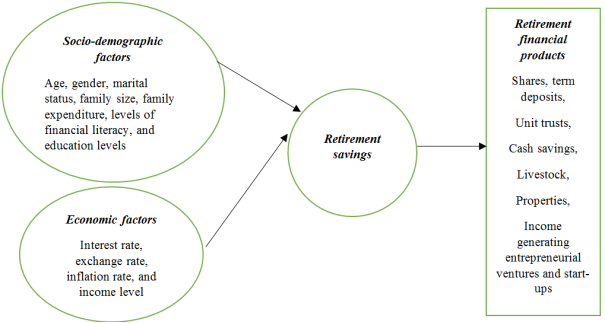
The life cycle theory was very instrumental in this study. The lifecycle hypothesis was postulated by Modigliani & Brumberg, in year 1954. It asserts that employees plan for current consumption and make savings over time . The school of thought further argues that, employees make savings during their working life to meet future consumption needs . The research examined the determinants that affect employees` ability to make adequate savings during working period, thus contributing to inadequate savings in the post-retirement. This therefore caused employees to heavily depend on National Social Security Authority (NSSA) pay-outs and the government pension upon retirement. The conceptual framework that was derived from the underpinning theory of life cycle hypothesis is illustrated in Figure 1 below;
Figure 1. The Conceptual framework, Source: Primary data (2025).
3. Research Methodology
The study used a positivist paradigm and a case study design where a sample of sixty employees out of a target population of six-hundred staff establishment. The population was stratified into lecturing and no-lecturing staff. Simple random sampling was then used to come up with a sample size of sixty (60) respondents out of the target population of six-hundred (600). Questionnaires were used to establish some sensitive issues which the respondents might have failed to express during interviews . To improve the quality and efficiency of the questionnaire, the researchers carried out a pilot study to ascertain the suitability of the instrument in addressing the research topic. Interview guides were also used to compliment the questionnaire. The study was carried out at Harare Polytechnic targeting both lecturing and non-lecturing employees.
4. Data Presentation and Discussion
The following findings were obtained from the study as follows;
4.1. The Socio-demographic Determinants Which Influence Retirement Savings of Employees in Tertiary Institutions of Zimbabwe
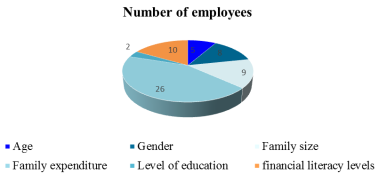
The research sought to ascertain the socio-demographic determinants that impact employees` saving behaviour It was established from the study that age, marital status, family size, family expenditure, level of education, and financial literacy levels of employees has an influence on retirement savings at the institution as illustrated in Figure 2 below.
Figure 2. The socio-demographic determinants which influence retirement savings of employees in tertiary institutions of Zimbabwe, Source: primary data, (2025).
Figure 2 above illustrates that family expenditure was found to be the major contributing determinant which influenced retirement savings of employees in tertiary institutions of Zimbabwe with a higher percentage of 43% of the respondents followed by financial literacy levels with 17%. Level of education was the least contributing factor to retirement savings as it constituted 3% of the total respondents accessed in the study. The significance of socio-demographic determinants on retirement savings corroborated the study by Embong et al. (2021) investigated the factors that influenced financial well-being of the retirees where family expenditure, financial literacy levels, family size, and gender were found to be some of the contributing factors to financial decision making and business performance . In the study by Yahiaoui (2023) which sought to establish the determining factors of financial literacy on students, it was established that age, level of education, and family background were among the key factors which influenced financial literacy and savings decisions of university students .
4.2. The Economic Factors That Influence Retirement Savings of Employees in Tertiary Institutions of Zimbabwe
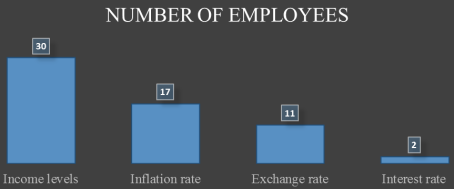
The research sought to ascertain the economic factors that impact employees` saving behaviour. It was established from the study that income level, interest rate, exchange rate, and inflation rate were some of the economic factors that has an influence on retirement savings at the institution as illustrated in Figure 3 below.
Figure 3. The economic factors which influence retirement savings of employees in tertiary institutions of Zimbabwe, Source: primary data, (2025).
Figure 3 above illustrates that income level was found to be the major contributing factor which influence retirement savings of employees in tertiary institutions of Zimbabwe with a higher percentage of 50% of the respondents followed by inflation rate with 28%. Interest rate was the least contributing factor to retirement savings as it constituted 3% of the total respondents accessed in the study. This corroborated with the study of Boddy, et al. (2015), Surya Dewi, et al. (2023) and Mokhtar, & Husniyah (2017) who investigated the determining factors of financial well-being and they established that income levels, inflation rate, exchange rate and interest rates were some of the determinants that influence financial well-being, and .
5. Conclusion and Recommendations
The research findings showed that there are various determinants which influence retirement savings in tertiary institutions of Zimbabwe. These were categorised into socio-demographic and economic determinants. The socio-demographic determinants that influence retirement savings were age, marital status, family size, family expenditure, educational level, and level of financial education of employees whilst the economic determinants included income level, interest rate, exchange rate, and inflation rate. The interventions that would enhance increased retirement savings of employees in tertiary institutions of Zimbabwe were recommended as follows;
Employees of tertiary institutions were recommended to attend financial literacy training so as to acquaint themselves with creation of entrepreneurial ventures and start-ups for income generation, attend savings and investment management training. These training sessions would expose employees to various financial products that they could utilise in order to save for retirement such as shares, term deposits, unit trusts, cash savings options, investment in gold coins, livestock, properties, diversified asset portfolio, fixed savings accounts, and other various income generating projects that employees could utilise in order to boost their retirement savings rather than relying solely on NSSA and government pension.
The management of tertiary institutions were recommended to positively influence retirement savings by funding employees with low financial literacy levels to attend financial literacy programs in order to acquaint them on how to make retirement savings for use in the post-retirement phase. Furthermore, there is need for the management of tertiary institutions to arrange quarterly and semi-annual seminars and conferences on retirement planning and ways to mobilise retirement savings from successful people in form of guest lectures. Attendance to these conferences should be mandatory to every employee where they would get a certificate of attendance for presentation to accounting officers of each tertiary institution. The attendance to these educational functions would improve the quality of financial education and positively influence employees` attitude towards retirement savings.
Policy makers were recommended to develop a holistic approach to address the obstacles faced by employees which affects retirement savings and also inculcate the culture of saving by the entire government workforce through approval of institutional-based income generating entrepreneurial ventures and start-ups where excess funds would be channeled towards retirement savings. Policy makers were also recommended to formulate customized-institutional policies which promote the culture of saving among employees. Furthermore, there is need for policy makers to collaborate with financial institutions in the dissemination of financial advisory services to employees and educate employees on the existing defined contribution retirement plans.
Abbreviations

NSSA

National Social Security Authority

ZIMSTATS

Zimbabwe Statistical Agency

USD

United States Dollar

ZWD

Zimbabwean Dollar

SSA

Sub Saharan Africa

HIV

Human Immune Virus

AIDS

Acquired Immune Deficiency Syndrome

AFD

African Development Bank

Conflicts of Interest
There is no conflict of interests by authors on the paper.
References
[1] Abidin, Z. Z., & Zainuddin, A. (2021). Financial Literacy on Retirement Planning Among Working Single Women In Private Sector, Selangor. The 2nd International Conference on Innovations in Social Sciences Education and Engineering ( ICoISSEE ), 1-15.
[2] African Development Bank Group. (2024). Country Focus Report 2024. African Development Bank Group.
[3] Blessing, O., & Ph, A. N. D. (2021). Retirement Planning Involvement and Challenges Encountered by Staff of Public Universities in Rivers State, Nigeria. 4002(4), 243-251.
[4] Boddy, D., Dokko, J., Hershbein, B., & Kearney, M. S. (2015). Ten Economic Facts about Financial Well-Being in Retirement.
[5] Comerton-Forde, C., de New, J., Salamanca, N., Ribar, D. C., Nicastro, A., & Ross, J. (2022). Measuring Financial Wellbeing with Self-Reported and Bank Record Data*. Economic Record, 98(321), 133-151.
[6] Dhlembeu, N. T., Kekana, K., & Mvita, M. F. (2023). The Influence of Financial Literacy on Retirement Planning in South Africa. In SSRN Electronic Journal.
[7] Embong, A. M., Afzainizam, N., Norhashim, M., & Ahmadi, A. (2021). Investigating the business performance on the financial well-being of the Government retirees. SHS Web of Conferences, 124, 03006.
[8] Fanta, A., & Mutsonziwa, K. (2021). Financial Literacy as a Driver of Financial Inclusion in Kenya and Tanzania.
[9] Ghadwan, A., Marhaini, W., Ahmad, W., & Hanifa, M. H. (2022). Financial Planning for Retirement : The Mediating Role of Culture.
[10] Ghadwan, A. S., Wan Ahmad, W. M., & Hisham Hanifa, M. (2023). Financial Planning for Retirement: The Moderating Role of Government Policy. SAGE Open, 13(2), 1-16.
[11] Hassan, K. H., Rahim, R. A., Ahmad, F., Tengku Zainuddin, T. N. A., Merican, R. R., & Bahari, S. K. (2016). Retirement Planning Behaviour of Working Individuals and Legal Proposition for New Pension System in Malaysia. Journal of Politics and Law, 9(4), 43.
[12] Hauff, J. C., Carlander, A., Gärling, T., & Nicolini, G. (2020). Retirement Financial Behaviour: How Important Is Being Financially Literate? Journal of Consumer Policy, 43(3), 543-564.
[13] Jaffar, N., Mohd Faizal, S., Selamat, Z., Awaludin, I. S., & Sulaiman, N. A. (2024). Financial literacy and financial well-being of low-income women in Malaysia: a capability view. Cogent Social Sciences, 10(1).
[14] Kamakia, M. G., Mwangi, C. I., & Mwangi, M. (2017). Financial Literacy and Financial Wellbeing of Public Sector Employees: A Critical Literature Review. European Scientific Journal, ESJ, 13(16), 233.
[15] Karakara, A. A.-W., Sebu, J., & Dasmani, I. (2022). Financial literacy, financial distress and socioeconomic characteristics of individuals in Ghana. African Journal of Economic and Management Studies, 13(1), 29-48.
[16] Khawar, S., & Sarwar, A. (2021). Financial literacy and financial behavior with the mediating effect of family financial socialization in the financial institutions of Lahore, Pakistan. Future Business Journal, 7(1), 1-11.
[17] Kim, K. T., & Lee, J. (2024). Unlocking Financial Well-Being for People With Disabilities: The Importance of Financial Knowledge and Socialization Within the Family Context. SAGE Open, 14(2).
[18] Mohd, J., Kadir, A., Zainon, S., Fadhilah, R., Noor, S., & Aziz, A. (2020). Retirement Planning and its Impact on Working Individuals. 7(06), 1550-1559.
[19] Mokhtar, N., & Husniyah, A. R. (2017). Social sciences & humanities Determinants of Financial Well-Being among Public Employees in Putrajaya, Malaysia. Pertanika J. Soc. Sci. & Hum, 25(3), 1241-1260.
[20] Mustafa, W. M. W., Islam, M. A., Asyraf, M., Hassan, M. S., Royhan, P., & Rahman, S. (2023). The Effects of Financial Attitudes, Financial Literacy and Health Literacy on Sustainable Financial Retirement Planning: The Moderating Role of the Financial Advisor. Sustainability (Switzerland), 15(3).
[21] Ncube, C. M., & Goodman Nhapi, T. (2022). Un-African Aging? Discourses of the Socio-Spatial Welfare for Older People in Urban Zimbabwe. Architecture and Culture, 10(1), 156-173.
[22] Njoka, C. (2021). Financial literacy and personal retirement planning : a socioeconomic approach. 1(2), 121-134.
[23] Olubukola, O. A., Kudzanai, M., Shepard, M., Thomas, B., & Obert, S. (2021). Saving practices and economic performance: A Zimbabwean case 1980-2015. In Asian Economic and Financial Review (Vol. 11, Issue 2, pp. 118-128). Asian Economic and Social Society.
[24] Rubaba, L. (2015). Savings Culture in Zimbabwe Post Dollarization: Policy Issues.
[25] Sajuyigbe, A. S., Adegun, E. A., Adeyemi, F., Johnson, A. A., Oladapo, J. T., & Jooda, D. T. (2024). The Interplay of Financial Literacy on the Financial Behavior and Well-being of Young Adults: Evidence from Nigeria. Jurnal Ilmu Ekonomi Terapan, 9(1), 120-136.
[26] Saunders, M., Lewis, P., & Thornhill, A. (2007). Research Methods for Buniess Students. In Pearson.
[27] So, W. K. W., Au, D. W. H., Chan, D. N. S., Ng, M. S. N., Choi, K. C., Xing, W., Chan, M., Mak, S. S. S., Ho, P. S., Tong, M., Au, C., Ling, W. M., Chan, M., & Chan, R. J. (2023). Financial well-being as a mediator of the relationship between multimorbidity and health-related quality of life in people with cancer. Cancer Medicine, 12(14), 15579-15587.
[28] Soepding, B. A., Munene, J. C., & Dang, D. Y. (2022). Financial well-being of Retirees Community in Nigeria. In Journal of Enterprising Communities (Vol. 16, Issue 2, pp. 341-358).
[29] Surya Dewi, P. S., Margaretha Leon, F., & Endang Purba, Y. (2023). Factors that affect financial well-being in master program students. International Journal of Management Studies and Social Science Research, 05(01), 163-174.
[30] Tafirenyika, N., & Kuye, J. O. (2016). The social security policy of the Government of Zimbabwe: a policy analysis overview.
[31] Theodorus Sutadi, & Tri Rahmawati, C. H. (2024). The Influence of Financial Literacy on Green Investment Decisions. Al-Kharaj: Jurnal Ekonomi, Keuangan & Bisnis Syariah, 6(6).
[32] Yahiaoui, N. E. H. (2023). Demographic and socio-economic determinants of multidimensional financial literacy among young algerian university students. Journal of Management and Business Education, 6(2), 199-221.
[33] Zazili, A. S. A., Ghazali, M. F. Bin, Abu Bakar, N. T. B., Ayob, M. B., & Samad, I. H. B. A. (2017). Retirement Planning: Young Professionals in Private Sector. SHS Web of Conferences, 00024.
Cite This Article
  • APA Style

    Dhewa, C., Makurumidze, S., Mashizha, M. (2025). Determinants for Retirement Savings of Employees in Tertiary Institutions of Zimbabwe. Science Futures, 1(1), 21-27. https://doi.org/10.11648/j.scif.20250101.13

    Copy | Download

    ACS Style

    Dhewa, C.; Makurumidze, S.; Mashizha, M. Determinants for Retirement Savings of Employees in Tertiary Institutions of Zimbabwe. Sci. Futures 2025, 1(1), 21-27. doi: 10.11648/j.scif.20250101.13

    Copy | Download

    AMA Style

    Dhewa C, Makurumidze S, Mashizha M. Determinants for Retirement Savings of Employees in Tertiary Institutions of Zimbabwe. Sci Futures. 2025;1(1):21-27. doi: 10.11648/j.scif.20250101.13

    Copy | Download

  • @article{10.11648/j.scif.20250101.13,
      author = {Clever Dhewa and Shepard Makurumidze and Margaret Mashizha},
      title = {Determinants for Retirement Savings of Employees in Tertiary Institutions of Zimbabwe},
      journal = {Science Futures},
      volume = {1},
      number = {1},
      pages = {21-27},
      doi = {10.11648/j.scif.20250101.13},
      url = {https://doi.org/10.11648/j.scif.20250101.13},
      eprint = {https://article.sciencepublishinggroup.com/pdf/10.11648.j.scif.20250101.13},
      abstract = {Retirement savings are critical role for ensuring financial security of employees in the post-retirement phase, and a variety of factors significantly influence employees` ability to make retirement savings. The existence of retirement savings is important when planning for retirement mainly in the face of increased life expectancy, high cost of living, and the increased retirement age of employees in Zimbabwe. This research sought to examine the determining factors of retirement savings among employees in tertiary institutions with focus on one institution in Harare. The determinants that affect workers` retirement savings are identical across all other tertiary institutions hence the findings from the study would be a representative of other tertiary institutions across Zimbabwe. The study adopted a positivist paradigm and was a case study research where a sample of sixty respondents out of an accessible population of six-hundred staff establishment. The population was stratified into lecturing and non-lecturing staff. Simple random sampling was employed to come up with a sample size of sixty (60) respondents. Structured questionnaires and interview guides were used for collection of data. The study established that retirement savings were affected by age, marital status, gender, family size, family expenditure, level of education, financial literacy levels, interest rate, income level, exchange rate, and inflation rate. The study recommended that employees should attend financial literacy trainings together with savings and investment conferences so as to acquaint themselves with the general savings and investment management process that they could use. Such trainings would expose employees to various financial products such as shares, term deposits, unit trusts, cash savings, gold coins, investment in livestock, properties, diversified asset portfolio, fixed savings accounts, income generating projects, and other small business entrepreneurial ventures and start-ups. The management of tertiary institutions were recommended to positively influence employees to engage in retirement savings by funding employees to attend financial literacy and investment management training such that they would acquire the necessary knowledge to make savings and investments for post-retirement. Furthermore, institutions were recommended to hold quarterly and semi-annual seminars and conferences on retirement planning and retirement savings and make attendance by employees’ mandatory such that their attitude on retirement savings increases.},
     year = {2025}
    }
    

    Copy | Download

  • TY  - JOUR
    T1  - Determinants for Retirement Savings of Employees in Tertiary Institutions of Zimbabwe
    AU  - Clever Dhewa
    AU  - Shepard Makurumidze
    AU  - Margaret Mashizha
    Y1  - 2025/12/09
    PY  - 2025
    N1  - https://doi.org/10.11648/j.scif.20250101.13
    DO  - 10.11648/j.scif.20250101.13
    T2  - Science Futures
    JF  - Science Futures
    JO  - Science Futures
    SP  - 21
    EP  - 27
    PB  - Science Publishing Group
    SN  - 3070-6289
    UR  - https://doi.org/10.11648/j.scif.20250101.13
    AB  - Retirement savings are critical role for ensuring financial security of employees in the post-retirement phase, and a variety of factors significantly influence employees` ability to make retirement savings. The existence of retirement savings is important when planning for retirement mainly in the face of increased life expectancy, high cost of living, and the increased retirement age of employees in Zimbabwe. This research sought to examine the determining factors of retirement savings among employees in tertiary institutions with focus on one institution in Harare. The determinants that affect workers` retirement savings are identical across all other tertiary institutions hence the findings from the study would be a representative of other tertiary institutions across Zimbabwe. The study adopted a positivist paradigm and was a case study research where a sample of sixty respondents out of an accessible population of six-hundred staff establishment. The population was stratified into lecturing and non-lecturing staff. Simple random sampling was employed to come up with a sample size of sixty (60) respondents. Structured questionnaires and interview guides were used for collection of data. The study established that retirement savings were affected by age, marital status, gender, family size, family expenditure, level of education, financial literacy levels, interest rate, income level, exchange rate, and inflation rate. The study recommended that employees should attend financial literacy trainings together with savings and investment conferences so as to acquaint themselves with the general savings and investment management process that they could use. Such trainings would expose employees to various financial products such as shares, term deposits, unit trusts, cash savings, gold coins, investment in livestock, properties, diversified asset portfolio, fixed savings accounts, income generating projects, and other small business entrepreneurial ventures and start-ups. The management of tertiary institutions were recommended to positively influence employees to engage in retirement savings by funding employees to attend financial literacy and investment management training such that they would acquire the necessary knowledge to make savings and investments for post-retirement. Furthermore, institutions were recommended to hold quarterly and semi-annual seminars and conferences on retirement planning and retirement savings and make attendance by employees’ mandatory such that their attitude on retirement savings increases.
    VL  - 1
    IS  - 1
    ER  - 

    Copy | Download

Author Information
  • Commerce Division, Harare Polytechnic, Harare, Zimbabwe

  • Faculty of Business Management Sciences and Economics, University of Zimbabwe, Harare, Zimbabwe
  • Faculty of Business Management Sciences and Economics, University of Zimbabwe, Harare, Zimbabwe